Friday, January 18, 2013

Guest Post: What Leaders Need: A Confident Confidant

By Ian Griffin
This piece originally ran on Ian's blog, then on Vital Speeches of the Day

Seven years ago this month, I started the Professionally Speaking blog. Now I’ve reached the milestone of 700 blog postings. This seems like a suitable moment to reflect on some of the key lessons I’ve learned from my experience in providing executive communications support to my clients in Silicon Valley and around the world. You know you’ve hired a world-class speechwriter and communications consultant when they embrace these seven qualities.

1: CEOs need a confident confidant
Sitting in meetings at major Silicon Valley companies such as Sun Microsystems, Hewlett-Packard and Cisco, I’m often the only person in the room without a few thousand people reporting to them or a multi-billion-dollar target to meet. This can be an incredibly useful role that a CEO will come to value. As the speechwriter, I’m the one person in the room the CEO can turn to without an agenda of my own to advance. A CEO once told me, “Ian, it’s lonely at the top. I’ve seen every scam that managers can pull to cover their rear ends. I need someone like you who can tell it like it is.”
Key Lesson: Speechwriters with the confidence to speak up become the confidant and trusted adviser of a senior executive.

2: Be an impartial observer
I was brought in to edit an annual report for a European client with four separate divisions. My role was to resolve the different viewpoints of each group. The VP of Communications needed an outside consultant with the independence required to be able to write a cohesive document. Executive communications professionals are in a unique position to be an impartial observer in large organizations with multiple departments and competing interests.
Key Lesson: Take the initiative and tell the truth, no matter what certain executives want to hear. But don’t take sides within a company. We need to keep lines of communication open to all parties.

3: Take complexity out
Companies are filled with subject matter experts (SMEs) in engineering, finance, marketing, and sales. A speechwriter is a jack-of-all-trades, master of none. That’s our hidden value to a company. It’s my job to know a little bit about everything the company does, and then to know who to ask for answers when I need details. But lack of detail is rarely an issue. Time and again, I’ve asked SMEs for the background needed for 5-10 minutes of a speech only to be given enough data for a two-day seminar. My job is to absorb enormous volumes of data and take the complexity out; to find a way to communicate the message without putting the audience to sleep.
Key Lesson: Learn to simplify. Only include what is necessary to convey what is essential. As Einstein said, “Everything should be made as simple as possible, but not simpler.”

4: Tell compelling stories
As has been noted by others, people may not remember what you did or said but they will always remember how you made them feel. Audiences forget facts but they remember stories. Once you get past the jargon, the corporate world is an endless source of fascinating stories. I’ve found the best source of great stories for speeches come from informal chats when you are sitting down over coffee or, as I did one memorable afternoon, sharing a beer and pizza with the CEO in Boston’s North End. We talked about our time there as students. He shared a story about the lessons he’d learned outside the Harvard classroom that I used in a future speech.
Key Lesson: Always listen for stories executives tell about their childhood, family life, hobbies, early career and more. Dig for specifics. As speech coach Patricia Fripp says: “Specificity builds credibility.”

5: Embrace multimedia
The one-hour keynote is an endangered species. Conference organizers know audiences have short attention spans. Given travel budget restrictions, many organizations are turning to virtual meetings. Executives now need to feel comfortable on camera as well as on the podium. My three years as a communications consultant at Cisco introduced me to the exciting possibilities of TelePresence meetings. I also enjoyed access to fully-equipped TV studios to produce All Hands meetings. But it was just as exciting working with the limitations of a simple Flip camera, capturing video which I edited with Windows Movie Maker. These days it’s not just enough to write clever speeches, you need to keep current with the latest in multimedia technology.
Key Lesson: Digital media expands the boundaries of executive communications. Suggest it as an alternative to travel; use it to time-shift; create content that includes outdoor shots, audience testimonials and impromptu out-takes; record staff interviews; livestream events; experiment with transmedia storytelling.

6: Open up the backchannel
The audience is no longer silent. They might look like they are sitting quietly, but a raging debate on what Cliff Atkinson called The Backchannel can occur within and beyond the confines of the presentation venue. I’m amazed at the resistance some speakers have to this. My experience curating Twitter hashtags for specific events shows that there’s a rapidly emerging opportunity to magnify the impact of a speech and increase the reach beyond the walls of the auditorium.
Key Lesson: Learn about and embrace the backchannel. Make sure your executive has a Twitter account and use it for shameless self-promotion and to stimulate a lively debate before, during and after each presentation they make.

7: Learn to ask the right questions
As a communications professional, it’s not your role to out-gun the SMEs, VPs and assorted executives in the C-Suite when it comes to content. Our role is to ask what headline the CEO wants the speech to generate. To find out the audience’s hot buttons. To uncover the unique point of view the speaker brings to the issue. If there’s one lesson I’ve taken away from the work I’ve done for clients, it’s to always be ready to ask “Why is that?” when they suggest a point they want to make in a speech. Then, when they give an answer, having the courage to ask the same question again. It’s often only after they answer for the third time that the core of the speech is revealed.
Key Lesson: Don’t hurry to get to a final draft. Be professional and respect deadlines, but keep asking questions until you reach an answer that will make the audience sit up and take notice.
What executive communications lessons have you learned?

Ian Griffin is a veteran speechwriter and blogger at Professionally Speaking who helps high-level executives craft their communications. He previously worked in the corporate communications departments at Cisco, Hewlett-Packard, and Sun Microsystems and has over twenty years of speechwriting experience.

Thursday, January 3, 2013

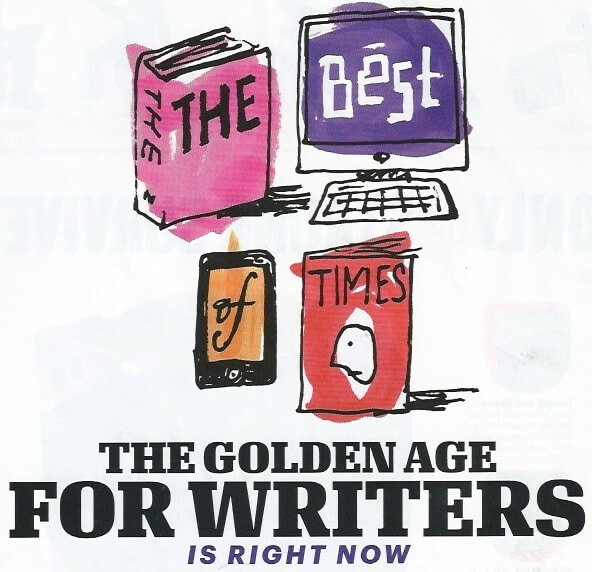
Writer Poll: Are We in a Golden Age of Writing?

Esquire recently published a piece called "The Golden Age for Writers," which argues that writers have no idea how lucky they are to live in these times of plenty for all things surrounding the written word.

Evidence cited for this claim includes new blockbusters coming out this year by powerhouse writers like Salman Rushdie and Zadie Smith, the fact that J.K. Rowling is a billionaire, and the way Fifty Shades of Grey has swept the world. In addition, publisher revenues are up, and there is more excellent long-form writing available to more people than ever before. The crux of the piece: "Literary circles have been so full of pity for so long that they can't accept the optimistic truth: We're living in a golden age for writers and writing."

Did Esquire miss something major in their relentlessly rosy assessment? Or is it time for everyone to stop howling about the death of the written word? We decided to go straight to the source and ask our vast network of hard-working writers to weigh in.

The positive
I totally agree. The article didn’t even touch on our ability to put out our own ebooks at will and sell them on Amazon, one of the largest search engines online. Writers now are truly blessed!
Carol Tice

Yes, everything is going digital but websites can't function without words. I'm constantly approached by businesses looking for words for their social media, blogs, or websites. Marketing copywriting and social media writing can earn you a steady income while you focus on passion projects on the side. There are many writers (like Diablo Cody, Amanda Hocking, and Kelly Oxford) who found success through social media and self-publishing. There are few barriers holding us back. We can market and publish ourselves, which brings an insane amount of opportunity for writers.
Aubre Andrus

I think we are at the beginnings of a golden age for writers due to the proliferation of paths by which writers can get their work in front of readers: print on demand, partner publishing with companies like Greenleaf Book Group, funding via sources like Kickstarter and PubSlush, direct-to-ebook publishing via the Kindle store or through companies like BookBaby, and so on. For ghosts, more paths to publishing means more people writing books and more quality work for us. Sure, doing all your own marketing is a lot of work, but since when was being a successful writer not a lot of work? I think this is a great time to be a writer, so long as you're entrepreneurial.
—Tim Vandehey

We are witnessing a resurgence for authors as we have grappled with and figured out ways to take advantage of new technologies and the Internet. As a ghostwriter, my business is certainly increasing. Yes, I too suffered through the doldrums of believing our industry and our very lives were heading over our own fiscal cliff. But all the way back in 1995, my MFA writing professor announced that we students were getting into the writing business just as it was dying. Perhaps people perpetually make these claims to discourage others, to thin out the herd.  
Alex Dahlberg  

Certainly the availability of written works in electronic form and new advances in self-publishing are both good for writers. But the Internet and social media have enticed regular people (not professional writers) to do much more writing than ever before. Vast numbers of people are writing more than ever, because they have the motivation that every English comp instructor has struggled for so many years to provide: to write about something you know and care about and have some aim or purpose with regard to the reader. The world is now one big writing workshop! 
Alan Perlman, PhD


The dubious
Content is still king, but all of us who deal in content—one way or the other, in any venue—are trying to figure out the new rules of the game. And we have to start from the position that even if we do figure out the rules today, they will be very different in a year’s time. So yes, there are more outlets, but we face a lot more complications and the road map isn’t clear.
Al Emid

I agree with the premise on one side: There are now, thanks to the Web, an infinite number of outlets for anybody who wants to express an idea or tell a story. On the other side, while I see that for authors who hit it out of the park, there is more visibility to be had, a larger audience of readers, and more money to be made than ever, the question is, is this not a zero-sum game? I think the long-term answer is going to be that writers will become entrepreneurial and learn to use the Web and other tech to promote and distribute their own work. But in the interim, as with every other media business, writers will face more suffering before it gets better.
Robert Chandler

I do not "howl self-pityingly" about "the death of the written word"; I've put two daughters through college as a freelance writer. However, the Esquire view is just nutty. Writers today are expected to produce work for close to nothing! But the good news is that, because of the enormous demand for content to fill digital media, it is much easier today to get some stories published and have a bunch of published clips to show.
—Steven Flax

Yes, developments in technology, blogging, and social networking have made it simple for anyone who shares a thought or a comment to become a "writer." Does that make it a golden age for writing, though? This is doubtless a time of great quantity, but what about quality? I believe we should aspire to a golden age of literacy, which would benefit writers, publishers, and readers alike.
—Katie Light


The negative
If the Fifty Shades books are responsible for the rising numbers, discount those numbers. Those books are dreck. And in any case, sales are one thing, but income for writers from those sales is another. To the extent that the numbers reflect Amazon's long tail, they don't help writers much. Mid-list advances and income are incontrovertibly down (although the long-tailers and mid-listers never made enough anyway). For readers, though, it's tough to complain.
—Mike Bryan

Except for the fact that writers are making far less than Esquire paid in the 1960s and '70s, this truly is a “golden age”—for publishers.
David Kline

All that the Esquire piece seems to argue is that life's not so bad if you're Jonathan Franzen. If the author of the article had talked to more mid-listers or hopeful talents who can't get their first fiction placed among the Big Five, he might have reached a different conclusion.
—Mike Gural-Miaello

Sure! Golden age! Unless you're interested in pesky things like, oh, getting paid. And I would point to Esquire's own website, where they pay a WalMart-like $150 for a 1,000-word piece. Where do I apply for food stamps again?
—Allen St. John


What do you think of our writers' conclusions? Tell us in the comments. And by all means, keep writing!

Thursday, December 20, 2012

Happy Holidays!

It's the most wonderful time...

The GG offices will be closed from December 24th through January 2nd. We will still be answering emails, though, so if there's anything pressing, feel free to write: info@gothamghostwriters.com.

Wishing a warm and happy holiday to all, and a very, very happy new year. See you in 2013!

Wednesday, December 19, 2012

GG Holiday Happy Hour 2012


This week we held our fourth annual GG Holiday Happy Hour! Dozens of writers gathered at our favorite ghost haunt, the Half King, to schmooze and swap tales of the trade.

Here's a rare glimpse of some of our ghosts—unmasked.


Happy holidays from all of us at Gotham!

Monday, December 10, 2012

Guest Post: For Writers—and Men—This Is What Collaboration Looks Like

by David Murray

This piece first ran in Huffington Post. Click here for the original.

I am the editor of Vital Speeches of the Day, a monthly magazine that collects the best speeches in the world. Many of its subscribers are speechwriters for CEOs and political leaders. Speechwriters usually complain about one of two things: clients who won't work on the speech, and clients who work the speech to death.
Truly collaborative writing? Until this year, it had eluded me so thoroughly that I nearly rejected the suggestion of a onetime Pentagon speechwriter that I read the journals of Lt. Col. Mark Weber, who needed help to write a memoir for his three young sons, who would soon be without a father.
Weber, in his early 40s like me, was dying of cancer.
"I probably ain't the guy to do this," I emailed Weber after reading the manuscript.
"I am not a ghostwriter," I lectured Weber (who hadn't asked for a ghostwriter). "I believe in the deep connection between thoughts and words. Your thoughts must start with your own words."
Furthermore, I told him the book contained clichés that an editor would have to cut out "like tumors, painfully" and familiar phrases that would have to be "lanced, like benign polyps."
Finally, I told him I doubted he had the energy or the time left to do the kind of rewrite I was demanding.
Now that, my friends, is how you treat a terminal cancer patient.
"I love it, David," Weber replied.
He continued: "I absolutely have the time and energy to rewrite. In fact, I insist on it. I've been holding off on doing so until I can get someone to provide the kind of candor I need to hear, and it's been killing me. You're absolutely right about the ghostwriting thing. I do not want that. I want someone to beat the shit out of me so I can rewrite what needs to be rewritten in the right way... Iron sharpens iron... and all I've got so far is bread (cheerleaders)."
What was I supposed to do at that point? We quickly came to financial terms and set to work. After we agreed on an eight-chapter thematic structure—I suggested stories from the manuscript that fit into each chapter's theme—Weber went to work.
Work.
Despite a sepsis attack that hospitalized him, an emotional retirement ceremony attended by Joint Chiefs of Staff Chairman Martin Dempsey and a dangerous surgery, he produced a chapter per week. Meaning, he wrote a chapter of several thousand words, sent it to me for feedback, rewrote, rearranged and cut parts based on my advice and sent it back to me for a line edit, which he then incorporated into a final version. He did all that every week. For eight straight weeks. Cheerfully.
Our correspondence was at once fun and sarcastic, candid and concise. And it wasn't only about the language or the story structure. Sometimes we differed on philosophy. I'd say, You don't want to say this. And Weber would say, But this is what I believe. And I would say, Well, then let's find a way to say it that's more convincing to someone who doesn't agree with you. Someone like me.
At one of those rare loggerheads, I told him, "It's your book." He replied by telling me I didn't need to tell him that; he was well aware.
This project was what I never thought a collaboration could ever quite be: two people, on equal footing, with a proper sense of urgency—whatever else it is, death is a useful deadline—trying to express a philosophy, and in the process, making each other think and feel. At one point Weber told me that getting my chapter critiques, however harsh, was "like getting a Christmas present." I showed that to my wife and she put her hand on my back and her eyes filled with tears. Which was like getting a Christmas present.
What made this collaboration perfect?
It helped that we were both the same age, both husbands and dads. It probably helped that we were both men, with a few communication norms in common. And we simply liked each other.
But it was equally crucial that I didn't know the first thing about being a military officer and found myself unimpressed by many of his proudest career accomplishments, up to and including his having been hand-picked for war zone assignment by Gen. David Petraeus. Conversely, my leisurely writer's life allowed me to sit sufficiently in awe of Weber's other exploits. (Frustrated by his inability to communicate with Iraq's top military officer, Weber casually learned Kurdish in three months.)
And it was probably also good that I was playing golf between rounds of edits, while he commuted between the hospital bed and the computer. Sympathy, in an editor, is more useful than empathy.
As Weber said, iron sharpens iron.
But I'm glad there were only eight chapters in our outline, because as we neared the Afterword, I felt my iron softening considerably. Weber had gone from my literary partner to my pen pal. I found myself in some denial that, as I told my wife, "God is going to take my new buddy."
When Mark asked me if I'd be interested in a U.S. Army backpack, I told him I'd wear it on every journey I took for the rest of my life.
But I doubt there'll be another journey quite like this.
Tell My Sons is available in hardcover, and it makes an excellent holiday present.

Friday, December 7, 2012

Around the Word

Stranger than #Fiction. Twitter's has become a serious tool for building author platforms and marketing books, but lately it's taking on new roles in the writing and publishing processes. A company called Chirpify is developing a Twitter-based program to sell books directly. And we've been seeing the rise of Twitter fiction, with several ventures, like Twitter Novel Project, attempting to write a full-length book tweet by tweet, as well as entire narratives built on 140 characters, à la this fun experiment from The Guardian. Montreal writer Arjun Basu has had his Twitter short stories (which he calls "Twisters") optioned for film, and he just landed a traditional book deal. An even stronger sign of Twit-fic legitimacy came in October, when Twitter announced that it would be holding the first official Twitter Fiction Festival. Want to start your own Twitter-based masterpiece? Get some tips here.

'Tis the Season. All the critics are making their lists of the year's best and worst books, and checking them twice. BookRiot, Goodreads, and Publisher's Weekly have all decided the best books of 2012. Amazon, of course, has your bestsellers (bet you can't guess who won! Hint: it starts with an "F" and ends with "-ifty Shades of Grey"). About.com rounded up their "most disappointing" books of the year, and GalleyCat has made a "mix-tape tribute" to the most underrated. And because we're always thinking of the children, NYPL has a list of 100 must-read children's books published this year.

Give the Gift of Lit. Speaking of lists, here are some handy gift guides for book lovers of all sorts.
 What's on your list?

Thursday, November 29, 2012

Intern at Gotham Ghostwriters!

Ever wonder what goes on at a ghostwriting firm? Here's your chance to find out! Gotham is looking for an ace intern, preferably a college student, who is interested in social media, publishing, and the business of freelance writing, to join our team for the spring semester.


Editorial & Social Media Intern
Gotham Ghostwriters is seeking a college student who is knowledgeable and passionate about the craft and business of content creation to support our company's expanding workload. The intern will be tasked with following the latest developments in the publishing and media industries, assisting with our social networking efforts, drafting blog posts, and performing general administrative tasks. Excellent writing skills are a must.

The intern will work 12–16 hours a week, days and times negotiable. The internship will start in January and run for a semester, with the possibility of continuing through the rest of the year.

Apply on BookJobs or by sending your resume & cover letter to info@gothamghostwriters.com.