
Showing posts with label speechwriting. Show all posts
Showing posts with label speechwriting. Show all posts
Monday, April 18, 2016

Monday, February 8, 2016
Guest Post: Speechwriter, Write
By Michael Long
Those of us who like Americana or alt-country music—country music with rock sensibilities—can be obsessive and last year, boy, were we. All through 2015, the golden boy of Americana, Ryan Adams, teased out the delivery of his new album, except it wasn’t quite a new album. It was going to be a song-for-song remake of one of the biggest records of the decade, Taylor Swift’s pop confection 1989. And Adams wasn’t going to do it ironically. He would sincerely reinterpret Swift’s songs by playing and arranging and singing them as he would his own.

This seemed an odd plan, recasting the dance-pop of Ms. Swift as the grungy guitar-in-the-garage roar of Mr. Adams. Her well-polished pop gems—huge hits such as “Shake It Off” and “Bad Blood”—were hard to imagine as anything but summertime soundtracks and club workouts. Yet when Ryan Adams’ 1989 was released in September 2015, it was clear he had produced something intriguing, very good, and completely his own.
If you somehow hadn’t heard of 1989 by Taylor Swift by the time you heard the Adams version, you would assume this new recording was, as usual, written by Mr. Adams. It sounds like a typical Ryan Adams record. But it wasn't even Mr. Adams' songs. It was written by Taylor Swift—nearly word for word, melody for melody, and chord for chord.
The feelings you get when you hear one of these albums versus the other are absolutely different. How can these recordings be so dissonant in effect when their foundations are the same?
The answer tells us something basic about art that speechwriters ought to remember about their craft. Presentation is, as the old line goes, all about the singer, not the song.
I tell speechwriters to stop writing for the speaker’s “voice.” Get the facts right. Get the organization down. Fuss over the structure. Know the topic. Learn the priorities of the audience and write to them. But don’t spend a second trying to find the so-called voice of the speaker, because personality and style—the fundamental aspects of voice—come out in delivery far more than in words.
Every speaker is unique, and he cannot hide his true nature—the singer, not the song. Give the same speech to two different people and you’ll hear two different speeches, even though the words are the same.
(I did stand-up comedy years ago. When we were starting out and my friends and I would see a comic who was better than we were, we'd say something like, "He could headline even with my act." We were being only a little hyperbolic. The material matters, but great delivery can elevate anything.)
Thus when the cheerleader’s Saturday night of “Shake It Off” is channeled through Ryan Adams, it comes out as the brooding, creepy obsession of a full-grown man. The pop queen’s naïve romantic poses in “Blank Space” emerge as a lonely last hope when Adams turns his delivery down to a whisper and pulls the simple melody through fingerpicked, arpeggiated chords.
As the writer, your best move is to get the content right and to find an effective structure. That’s a matter of intellect, not of following around your client for days making notes about how she uses prepositions. You’re not going to turn a buttoned-down CEO into a bouncing motivational speaker by capturing his “voice” in words. Don't imagine that the qualities of performance arise from filigree on the page. Coaches and writers have very different jobs.
Michael Long is a professional speechwriter, playwright, and writing teacher.
This piece was originally posted on Vital Speeches of the Day.
Those of us who like Americana or alt-country music—country music with rock sensibilities—can be obsessive and last year, boy, were we. All through 2015, the golden boy of Americana, Ryan Adams, teased out the delivery of his new album, except it wasn’t quite a new album. It was going to be a song-for-song remake of one of the biggest records of the decade, Taylor Swift’s pop confection 1989. And Adams wasn’t going to do it ironically. He would sincerely reinterpret Swift’s songs by playing and arranging and singing them as he would his own.

This seemed an odd plan, recasting the dance-pop of Ms. Swift as the grungy guitar-in-the-garage roar of Mr. Adams. Her well-polished pop gems—huge hits such as “Shake It Off” and “Bad Blood”—were hard to imagine as anything but summertime soundtracks and club workouts. Yet when Ryan Adams’ 1989 was released in September 2015, it was clear he had produced something intriguing, very good, and completely his own.
If you somehow hadn’t heard of 1989 by Taylor Swift by the time you heard the Adams version, you would assume this new recording was, as usual, written by Mr. Adams. It sounds like a typical Ryan Adams record. But it wasn't even Mr. Adams' songs. It was written by Taylor Swift—nearly word for word, melody for melody, and chord for chord.
The feelings you get when you hear one of these albums versus the other are absolutely different. How can these recordings be so dissonant in effect when their foundations are the same?
The answer tells us something basic about art that speechwriters ought to remember about their craft. Presentation is, as the old line goes, all about the singer, not the song.
I tell speechwriters to stop writing for the speaker’s “voice.” Get the facts right. Get the organization down. Fuss over the structure. Know the topic. Learn the priorities of the audience and write to them. But don’t spend a second trying to find the so-called voice of the speaker, because personality and style—the fundamental aspects of voice—come out in delivery far more than in words.
Every speaker is unique, and he cannot hide his true nature—the singer, not the song. Give the same speech to two different people and you’ll hear two different speeches, even though the words are the same.
(I did stand-up comedy years ago. When we were starting out and my friends and I would see a comic who was better than we were, we'd say something like, "He could headline even with my act." We were being only a little hyperbolic. The material matters, but great delivery can elevate anything.)
Thus when the cheerleader’s Saturday night of “Shake It Off” is channeled through Ryan Adams, it comes out as the brooding, creepy obsession of a full-grown man. The pop queen’s naïve romantic poses in “Blank Space” emerge as a lonely last hope when Adams turns his delivery down to a whisper and pulls the simple melody through fingerpicked, arpeggiated chords.
As the writer, your best move is to get the content right and to find an effective structure. That’s a matter of intellect, not of following around your client for days making notes about how she uses prepositions. You’re not going to turn a buttoned-down CEO into a bouncing motivational speaker by capturing his “voice” in words. Don't imagine that the qualities of performance arise from filigree on the page. Coaches and writers have very different jobs.
Michael Long is a professional speechwriter, playwright, and writing teacher.
This piece was originally posted on Vital Speeches of the Day.
Friday, August 21, 2015
Guest Post: Interview with a Heckler
Originally posted on Vital Speeches of the Day.
By David Murray
"Hecklers are vandals" was the headline of yesterday's post on my personal blog, Writing Boots.
 I was taking on Zoe Nicholson, a lifelong political activist who had objected on her Facebook page to the Bernie Sanders campaign's anti-heckling tactics. When Sanders is giving a speech and hecklers start chanting, "Black Lives Matter," Sanders backers are instructed to overwhelm the hecklers by chanting, "We Stand Together."
By David Murray
"Hecklers are vandals" was the headline of yesterday's post on my personal blog, Writing Boots.
 I was taking on Zoe Nicholson, a lifelong political activist who had objected on her Facebook page to the Bernie Sanders campaign's anti-heckling tactics. When Sanders is giving a speech and hecklers start chanting, "Black Lives Matter," Sanders backers are instructed to overwhelm the hecklers by chanting, "We Stand Together."
"Maddening," said Nicholson on Facebook. "All hecklers want is a voice and the issues prioritized. Shouting down is making them voiceless. That is the real message."
Aside from questioning a heckler's right to complain about being heckled back, I questioned—partly in defense of my fine-feathered speechwriting friends who work too hard on speeches to have them shouted down!—the effectiveness of heckling, and whether it's worth the social cost:
At best, it may alert some people to the idea that there are people who think, for instance, that George W. Bush or Barack Obama is a baby killer. But if you didn't know in the first place that people felt that way, you're probably not inclined to read further, because you never were a big reader in the first place.
Mostly, heckling just makes everyone embarrassed and sad, that people feel desperate or disrespectful enough to vandalize a community gathering, and destroy an attempt at communication.Happily, the heckler Nicholson responded in defense of heckling, writing, in part:
I am pleased that you quoted me and perfectly too. I am a real fan of heckling, personally. I began it with George Wallace in regards to civil rights and the Vietnam War. My teacher is Alice Paul, who learned it from Emmeline Pankhurst.
To really understand the organic effect of heckling you have to have the mission of pointing out to those in power that they need to prioritize the issues. For example, Senator Sanders was talking about the distribution of wealth and the hecklers wanted him to update his position on Black Lives Matter. It was not, 1) that he is a racist, 2) that his work in the 60s was ignored, or 3) redistribution of wealth is not important. And, the fact is—within 2 days his campaign did put out a NEW set of positions on the issues of the day. No matter how it appears—the fact is that it works.
I heckled POTUS on the repeal of DADT. I was chanted down and escorted out by the Secret Service. BUT President Obama prioritized and set a committee in place to investigate the effects on the armed forces should they allow LGB to openly serve. Obviously it was repealed.
It is the work of the militants to break convention. Heckling is a tried and true tool. But if you measure it on how the moderates react—it looks like rude immature shouting. However, the approval of the moderates is not the goal....
BTW—I just read that "Bernie rally tonight in LA opened with a woman giving a speech about Black Lives Matter. The cheers from the crowd were insane." Well done!I thanked Nicholson for her thoughtful response and added that "even if I don't necessarily buy your implied direct connection between your heckling and the repeal of DADT," her points were well taken.
Speechwriter—O megaphone for power!—how do you respond?
David Murray is executive director of the Professional Speechwriters Association. He's also editor of Vital Speeches of the Day magazine.
Friday, May 15, 2015
"Lincoln Speaks": A Review
By Dana Rubin
“Public sentiment is everything,” declared Abraham Lincoln in 1858 during his first senatorial debate with Stephen Douglas. “He who molds public sentiment, goes deeper than he who enacts statues or pronounces decisions.”
Lincoln thought public speaking was a more profound tool for influence and persuasion than the legislative or executive arenas. And his tool of choice was language. The development of his linguistic and rhetorical skills is the subject of "Lincoln Speaks: Words that Transformed a Nation" at the Morgan Library & Museum in New York.
Reflecting on his use of language, Lincoln scholar Harold Holzer—himself a onetime speechwriter for Mario Cuomo—calls Lincoln “an aspirational model for the modern politician.”
But was Lincoln truly a modern writer? In notes, letters, poems, pamphlets, scribbles, and speeches, the exhibit traces the growth of his literary and persuasive skills. It was language that helped him win his senatorial seat and the Republican nomination and presidency, sway public opinion during the prosecution of the Civil War, and pave the way for post-war reconciliation.
Growing up poor in a frontier town, the son of an illiterate and abusive father, Lincoln found refuge in books and poetry. With limited access, his reading was broad but not deep. He read the same works over and over—the King James Bible, Dickens, Aesop’s Fables, Shakespeare’s tragedies and histories, and Edgar Allan Poe. It’s the exact opposite of our reading habits today.
In an age without television, radio, or internet, the public had a tolerance for a certain windbaggery. Speakers at debates, rallies, and conferences would routinely drone on for two hours or more. Their words were then printed as a pamphlet or broadside and quoted in the newspapers.
Lincoln broke with convention by using language more sparingly. His speeches, which he wrote himself, were tighter than his contemporaries, his word choices simpler, his arguments more direct.
Prominent in the exhibit are copies of the three speeches now considered his greatest: the Second Inaugural, his Cooper Union speech, and the Gettysburg Address.
The Cooper Union address, which won him national attention and helped him gain the Republican nomination, was printed as a pamphlet in 1860. In it Lincoln anchored his anti-slavery argument in the thinking of the nation’s founders and predicted the ultimate end of slavery.
The Second Inaugural was published not long after the inauguration itself on March 4, 1865 as a large broadside in blue ink. With the Confederacy weakening, he used conciliatory language to reach out to his enemies and heal the wounded nation. He ended with the vision of “binding up the nation’s wounds”—borrowed from the Hebrew psalms.
Many today consider it Lincoln’s finest speech, but at the time Southerners detested his message and bitterly fought his nomination and election. After the assassination on April 15, it was reprinted—this time in black ink.
Then there’s the Gettysburg Address. Only 272 words, it memorializes the sacrifices of those who gave their lives on the battlefield in now iconic language. Tony Kushner calls it “a spectacular prose poem.”
For those of us who might want to learn from Lincoln’s craftsmanship, there are no original drafts in the exhibit, no notepads filled with scratched-out lines and ink blotches. We know Lincoln revised his speeches over and over, up until the last minute. But once the speech had been delivered, proofread, and typeset, he threw the drafts away. He wasn’t thinking of the archives.
So what kind of model was Lincoln for wordsmiths like us? To contemporary audiences, his spare and direct language is clearly more modern than his contemporaries. Yet there’s a quality of restraint that still sounds antique. I think that’s because Lincoln believed that to win public sentiment, a speaker must appeal to reason, not emotion. As a speechwriter he relied on principles and rational argument to do the heavy lifting.
Today we do the opposite. We enthusiastically use raw emotion to sway our listeners. We whip tension into frothy peaks and sloughs of despair like the most heavy-handed and manipulative Hollywood scriptwriters. Our professional gurus tell us a good speech has to play to our audiences’ emotions. Make them feel it in the kishkes.
We also worship at the altar of happiness. As professionals, that’s the state we’re all striving toward, right? But Lincoln was a gloomy guy. He suffered nervous breakdowns, bouts of melancholia, a dark and macabre dream life.
So how was he able to summon the language that would define so profoundly those turbulent times? How did he carry on despite so much suffering? Despite the wealth of documents, this exhibit can’t explain it—except to suggest he prevailed through language.
See it quick! The exhibit ends June 7.
This post originally appeared on Vital Speeches of the Day.
“Public sentiment is everything,” declared Abraham Lincoln in 1858 during his first senatorial debate with Stephen Douglas. “He who molds public sentiment, goes deeper than he who enacts statues or pronounces decisions.”

Lincoln thought public speaking was a more profound tool for influence and persuasion than the legislative or executive arenas. And his tool of choice was language. The development of his linguistic and rhetorical skills is the subject of "Lincoln Speaks: Words that Transformed a Nation" at the Morgan Library & Museum in New York.
Reflecting on his use of language, Lincoln scholar Harold Holzer—himself a onetime speechwriter for Mario Cuomo—calls Lincoln “an aspirational model for the modern politician.”
But was Lincoln truly a modern writer? In notes, letters, poems, pamphlets, scribbles, and speeches, the exhibit traces the growth of his literary and persuasive skills. It was language that helped him win his senatorial seat and the Republican nomination and presidency, sway public opinion during the prosecution of the Civil War, and pave the way for post-war reconciliation.
Growing up poor in a frontier town, the son of an illiterate and abusive father, Lincoln found refuge in books and poetry. With limited access, his reading was broad but not deep. He read the same works over and over—the King James Bible, Dickens, Aesop’s Fables, Shakespeare’s tragedies and histories, and Edgar Allan Poe. It’s the exact opposite of our reading habits today.
In an age without television, radio, or internet, the public had a tolerance for a certain windbaggery. Speakers at debates, rallies, and conferences would routinely drone on for two hours or more. Their words were then printed as a pamphlet or broadside and quoted in the newspapers.
Lincoln broke with convention by using language more sparingly. His speeches, which he wrote himself, were tighter than his contemporaries, his word choices simpler, his arguments more direct.
Prominent in the exhibit are copies of the three speeches now considered his greatest: the Second Inaugural, his Cooper Union speech, and the Gettysburg Address.
The Cooper Union address, which won him national attention and helped him gain the Republican nomination, was printed as a pamphlet in 1860. In it Lincoln anchored his anti-slavery argument in the thinking of the nation’s founders and predicted the ultimate end of slavery.
The Second Inaugural was published not long after the inauguration itself on March 4, 1865 as a large broadside in blue ink. With the Confederacy weakening, he used conciliatory language to reach out to his enemies and heal the wounded nation. He ended with the vision of “binding up the nation’s wounds”—borrowed from the Hebrew psalms.
Many today consider it Lincoln’s finest speech, but at the time Southerners detested his message and bitterly fought his nomination and election. After the assassination on April 15, it was reprinted—this time in black ink.
Then there’s the Gettysburg Address. Only 272 words, it memorializes the sacrifices of those who gave their lives on the battlefield in now iconic language. Tony Kushner calls it “a spectacular prose poem.”
For those of us who might want to learn from Lincoln’s craftsmanship, there are no original drafts in the exhibit, no notepads filled with scratched-out lines and ink blotches. We know Lincoln revised his speeches over and over, up until the last minute. But once the speech had been delivered, proofread, and typeset, he threw the drafts away. He wasn’t thinking of the archives.
So what kind of model was Lincoln for wordsmiths like us? To contemporary audiences, his spare and direct language is clearly more modern than his contemporaries. Yet there’s a quality of restraint that still sounds antique. I think that’s because Lincoln believed that to win public sentiment, a speaker must appeal to reason, not emotion. As a speechwriter he relied on principles and rational argument to do the heavy lifting.
Today we do the opposite. We enthusiastically use raw emotion to sway our listeners. We whip tension into frothy peaks and sloughs of despair like the most heavy-handed and manipulative Hollywood scriptwriters. Our professional gurus tell us a good speech has to play to our audiences’ emotions. Make them feel it in the kishkes.
We also worship at the altar of happiness. As professionals, that’s the state we’re all striving toward, right? But Lincoln was a gloomy guy. He suffered nervous breakdowns, bouts of melancholia, a dark and macabre dream life.
So how was he able to summon the language that would define so profoundly those turbulent times? How did he carry on despite so much suffering? Despite the wealth of documents, this exhibit can’t explain it—except to suggest he prevailed through language.
See it quick! The exhibit ends June 7.
This post originally appeared on Vital Speeches of the Day.
Monday, April 20, 2015
Your Speechwriter: An Operator’s Manual
by David Murray
This post originally appeared on The Strategist via PRSA
The first thing to know about speechwriters is that many of them prefer to be referred to as something else. In fact, an argument broke out among the delegates at the first World Conference of the PSA about this point:
“The term ‘speechwriter’ is limiting,” someone said, questioning the wisdom of the name of the new association. One suggestion was to call it the “Leadership Communication Association,” in order to acknowledge the broader role that so many speechwriters have: building thought leadership platforms, crafting executive messages for many media and coaching executives through various communication opportunities.
But other speechwriters rose to the defense of the old term. One person said it’s useful because “it fences me off” from others in the organization who would water the job down with other duties. A self-proclaimed “speechwriter” is a kind of brand that “excites people,” as opposed to broader but blander descriptors such as “executive communicator.”
Don’t hide your speechwriter
The PSA survey revealed that speechwriters are older, more likely to be male, better educated, and better paid than their colleagues in public relations. The typical speechwriter is a 51-year-old man with a master’s degree. More than half of the speechwriters surveyed make more than $100,000 annually, with 23 percent pulling in more than $150,000 (and half of those making more than $200,000).
Speechwriters are also more likely than their well-coiffed PR colleagues to be unkempt, unruly, unconventional—or all of the above. But do not punish them for this. Every organization should have one person who is deeply—and perhaps even a little single-mindedly—devoted to helping the leader articulate the organization’s point of view as compellingly as possible.
Most leaders know this and will tolerate—and sometimes embrace—a little eccentricity in a person who helps them sound, look, and feel better in front of important audiences.
Help out your speechwriter
Even with the best client-speechwriter chemistry—JFK called his speechwriter Ted Sorensen “my intellectual blood bank”—the speechwriter struggles to get sufficient access to achieve a real mind-meld with the boss.
Now add the litany of common troubles that PSA members listed in the survey: solitude, short deadlines, slow workflows, lawyers, and indifference.
Speechwriters resent clients who “don’t care about content”—and bureaucrats who care too much: “I have to contend with constant micromanaging by people who see risk lurking in every corner and are afraid of letting the CEO take any kind of position,” one survey participant said. “They also have no feel for what constitutes good writing, yet exert a huge influence over the process.”
A PR manager should not be one of those risk-averse bureaucrats. And when the lawyers or the HR staff or the compliance people start sucking the life from a piece of leadership communication, fight valiantly on your speechwriter’s behalf.
Even if you don’t win, your speechwriter will appreciate having an ally instead of one more institutional enemy.
Know what makes your speechwriter happy
Asked what they like most about their work, speechwriters said “shaping public debates,” “finding and telling stories,” “intellectual and creative challenge and reward,” “the variety of topics and amazing people that I get to work with” and “the silent hours when I, through writing, try to understand and share something important.”
Speechwriters are like snowflakes; some succeed precisely because they’re CEO whisperers. But many of the ones worth keeping around are the oddest and most difficult to please. They have razor intellects, a restless curiosity and healthy—if not slightly obese—egos.
But remember, lots of speechwriters are older. So they know by now that life in leadership communication will not lay itself neatly before them. So if they can see that they are achieving something significant with their work, if they can be intellectually stimulated, if they feel that someone, somewhere in the organization believes that the corporate strategy can be advanced by articulate rhetoric and communication, they will stick around and keep giving their best, despite it all.
Thirty years ago, a corporate speechwriter wrote, “No one is recording these speeches. There are no books of them that readers save and treasure. Our files will be tossed on the scrap heap when we leave or retire. But we have been sitting at a typewriter making land, a sea, a sky, burning words. That’s enough. It is more than most have.”
In the end, it’s all your speechwriter requires. That, and a salary somewhere in the low six figures.
But in exchange for helping your organization’s top leadership communicate compellingly, is that too much to ask?
This post originally appeared on The Strategist via PRSA
 |
[ikon images/corbis]
|
As far as PR positions go, the speechwriter probably has one of the most interesting (and borderline absurd) jobs. One describes his marching orders from the CEO as: “Write down my thoughts as if I had them.”
Until recently, this group didn’t have a formal forum to share what they do. But with the advent of the Professional Speechwriters Association (PSA) this past winter, we can now look into the realities of this position, thanks to the recently released results of its first-ever membership survey. The survey yielded insights about modern speechwriters that their managers and colleagues might find useful, as they try to coax sustainable excellence from this peculiar, but potentially powerful PR position.
The first thing to know about speechwriters is that many of them prefer to be referred to as something else. In fact, an argument broke out among the delegates at the first World Conference of the PSA about this point:
“The term ‘speechwriter’ is limiting,” someone said, questioning the wisdom of the name of the new association. One suggestion was to call it the “Leadership Communication Association,” in order to acknowledge the broader role that so many speechwriters have: building thought leadership platforms, crafting executive messages for many media and coaching executives through various communication opportunities.
But other speechwriters rose to the defense of the old term. One person said it’s useful because “it fences me off” from others in the organization who would water the job down with other duties. A self-proclaimed “speechwriter” is a kind of brand that “excites people,” as opposed to broader but blander descriptors such as “executive communicator.”
Don’t hide your speechwriter
The PSA survey revealed that speechwriters are older, more likely to be male, better educated, and better paid than their colleagues in public relations. The typical speechwriter is a 51-year-old man with a master’s degree. More than half of the speechwriters surveyed make more than $100,000 annually, with 23 percent pulling in more than $150,000 (and half of those making more than $200,000).
Speechwriters are also more likely than their well-coiffed PR colleagues to be unkempt, unruly, unconventional—or all of the above. But do not punish them for this. Every organization should have one person who is deeply—and perhaps even a little single-mindedly—devoted to helping the leader articulate the organization’s point of view as compellingly as possible.
Most leaders know this and will tolerate—and sometimes embrace—a little eccentricity in a person who helps them sound, look, and feel better in front of important audiences.
Help out your speechwriter
Even with the best client-speechwriter chemistry—JFK called his speechwriter Ted Sorensen “my intellectual blood bank”—the speechwriter struggles to get sufficient access to achieve a real mind-meld with the boss.
Now add the litany of common troubles that PSA members listed in the survey: solitude, short deadlines, slow workflows, lawyers, and indifference.
Speechwriters resent clients who “don’t care about content”—and bureaucrats who care too much: “I have to contend with constant micromanaging by people who see risk lurking in every corner and are afraid of letting the CEO take any kind of position,” one survey participant said. “They also have no feel for what constitutes good writing, yet exert a huge influence over the process.”
A PR manager should not be one of those risk-averse bureaucrats. And when the lawyers or the HR staff or the compliance people start sucking the life from a piece of leadership communication, fight valiantly on your speechwriter’s behalf.
Even if you don’t win, your speechwriter will appreciate having an ally instead of one more institutional enemy.
Know what makes your speechwriter happy
Asked what they like most about their work, speechwriters said “shaping public debates,” “finding and telling stories,” “intellectual and creative challenge and reward,” “the variety of topics and amazing people that I get to work with” and “the silent hours when I, through writing, try to understand and share something important.”
Speechwriters are like snowflakes; some succeed precisely because they’re CEO whisperers. But many of the ones worth keeping around are the oddest and most difficult to please. They have razor intellects, a restless curiosity and healthy—if not slightly obese—egos.
But remember, lots of speechwriters are older. So they know by now that life in leadership communication will not lay itself neatly before them. So if they can see that they are achieving something significant with their work, if they can be intellectually stimulated, if they feel that someone, somewhere in the organization believes that the corporate strategy can be advanced by articulate rhetoric and communication, they will stick around and keep giving their best, despite it all.
Thirty years ago, a corporate speechwriter wrote, “No one is recording these speeches. There are no books of them that readers save and treasure. Our files will be tossed on the scrap heap when we leave or retire. But we have been sitting at a typewriter making land, a sea, a sky, burning words. That’s enough. It is more than most have.”
In the end, it’s all your speechwriter requires. That, and a salary somewhere in the low six figures.
But in exchange for helping your organization’s top leadership communicate compellingly, is that too much to ask?
Monday, February 16, 2015
Guest Post: Patrick Sweeney, on the three audiences

by Neil Hrab
Speechwriters, don’t let your eyes deceive you. When writing a speech, you’re typically trying to help a speaker connect with not one, but three distinct audiences. Patrick Sweeney, an author, speechwriter and corporate executive, explains the three audiences as follows:
“There’s the audience who requested you to speak, a separate audience whose job is to interpret your message, and then there is the audience of your audience. What I mean is that, first, there’s the audience who invited you because they are interested in your perspective. They are looking for you to engage, inform and inspire them. The second audience comprises journalists who are covering the event. Journalists are listening for content and style, substance and memorable phrases. They have an appreciation for words and language, so through your speech, you are also seeking to give them a place to take their story, realizing that your phrases can suggest possible headlines and lead paragraphs.”
“And then there’s the third audience—the people whom your listeners will interact with following the speech. You need to consider what they will remember about the speech and share with family and friends at the dinner table, for example. When drafting a speech for New Jersey Governor Brendan Byrne, my goal was to keep these three audiences in mind, and write something that would, hopefully, resonate on all three of those levels.”
A talent for connecting with audiences is, in some ways, the thread that binds together Sweeney’s multi-faceted career. After graduating from college in 1974, Sweeney worked as a newspaper reporter, magazine editor and assistant to the producer of a current events TV program. He also wrote feature articles for the New York Times.
In 1978, Sweeney left journalism to become the primary speechwriter to Brendan Byrne, who had just been re-elected as Governor of New Jersey. Being new to speechwriting, Sweeney particularly appreciated how generously Byrne shared his time, thought process and guidance on draft speeches.
“In all honesty, it took a while to learn how to emulate the Governor’s style of speaking. I remember spending the first few weeks getting a sense of his cadence, his timing, and the way he liked to tell stories and make his points. He was very good at sharing with me what was working in a draft, and what I still needed to refine,” Sweeney recalled.
Sweeney would also research the subject matter for each speech, drawing on his experiences in journalism. “I would make sure the information in the draft was accurate, and then work with the Governor to create a message that clearly reflected his intent in a manner that was compelling.”
Sweeney observed some similarities between his journalism and his speechwriting: “To me, speechwriting is a unique combination of the typical news story format, with elements of feature writing. These are two completely different ways of telling a story. A news story is all about facts, with the important information up front, in case it needs to be edited for length. A feature story, on the other hand, usually starts with some intriguing observation or story up front to pull readers in and grasp their attention. By putting these two approaches together, you can capture feelings and facts, thoughts and emotions – which is what I found myself doing for the Governor as a speechwriter.”
While Sweeney was a journalist by background, and Byrne was a lawyer and former judge, the two shared a keen interest in ensuring that all speeches would connect in a moving way with their intended audiences.
“When he agreed to a speaking engagement, the Governor always had a very clear perspective on what message he wanted to communicate and how he would convey it. As we were developing a draft, he did not have to talk very long before I would often hear him say something that was very quotable. It was a very collaborative process, and the more time we spent with each other, the more effective I became as a speechwriter,” Sweeney said.
“With Governor Byrne, speaking engagements were opportunities to make a statement. So, he took the preparation very seriously. In the case of major addresses, for example, I would meet with him several months beforehand to discuss the speech. The Governor would explain the points he wanted to make and the impression he wanted to leave, as well as why he was doing the speech in front of this particular audience. I’d then craft the initial draft, and show it to him, and he’d say what he liked, where he wanted more details, where he might want the phrasing to be stronger, etc., and I would go back to work.”
For Sweeney, the most memorable speech that emerged from his work with Governor Byrne involved a March 4, 1981 speech in Philadelphia, PA. The Governor informed Sweeney he would use the speech to comment directly on then recently-elected President Reagan’s agenda. Byrne, a liberal Democrat, explained that he was not terribly impressed by Reagan’s claim that he could simultaneously balance the federal budget and increase military spending. “The math just doesn’t work,” Byrne told Sweeney. “There’s been a grace period for the new President, but I want to say that I feel like I am in the fairy tale where everyone seems to be admiring the new President’s clothes…but you can actually see right through them,” Byrne said.
Byrne further shared that, for this particular speech, he wanted Sweeney to confer via telephone with the renowned journalist and former editor of Saturday Review Norman Cousins. As a long-time admirer of Cousins’ work, Sweeney was thrilled to have the chance to collaborate with this legendary figure.
The speech delivered by Byrne to an audience of tri-state business leaders was a respectful but hard-hitting and carefully reasoned take-down of Reagan’s political program. It received extensive media coverage.
“I agree with the President that nothing is more important than our ability to defend ourselves,” Byrne said during the speech, “[but] the central question is: ‘What does our security depend upon?’ We cannot defend ourselves with 1890 ideas, any more than we can with 1890 weapons.”
On the President’s proposed military build-up, Byrne said: “We have human needs far more pressing than the foolish desire to continue building our stockpile of nuclear weapons…[For] if there was security in the arms race…we would certainly be secure by now….What are we doing [by building more nuclear weapons] except overloading our boats with life preservers to the point where there is no room for people?”
On the President’s plans to reduce the federal budget, Byrne adroitly observed Reagan wanted to “cut spending at every corner, unless those corners happen to be on the sites of military installations.”
Sweeney subsequently left the Governor’s office in 1981 to begin working at Caliper, an international management consulting company based in Princeton, NJ. His accomplishments at Caliper include: serving as the company’s president; co-authoring two books with the company’s founder; and acting as one of the company’s key spokespeople. Sweeney recently decided to venture on his own, taking a page from a New York Times bestselling book he co-authored called Succeed on Your Own Terms. He is currently hard at work on a new book to be published by McGraw-Hill.
In his own speaking engagements, Sweeney has carried with him several lessons from his speechwriting days. One of them is that, as a speaker, Governor Byrne “was always true to himself. He had his own style of speaking, which he honed. My style of speaking is different from the Governor’s. Still, I carry with me his advice about being true to myself, being clear about my message, and seeking memorable ways to truly connect.”
Another lesson is to practice for speaking appearances, just as Governor Byrne would do: “It’s about honoring your audience, and showing that you’ve given the appearance your full dedication, commitment and enthusiasm.”
For Sweeney, pulling this all together is about ensuring that the perspective he is sharing, the points he is making, the humorous anecdotes, the poignant accounts, and all of the final touches he adds to his speeches are not just there to be amusing or interesting in and of themselves. “Stories enrich speeches, certainly. They can touch us in ways that are very deep and meaningful. What matters is that they come authentically from the speaker’s experience, interest and heart. That is when they truly connect and become much more powerful,” Sweeney said.
***
Sweeney shared one more piece of advice about connecting with an audience – inspired by a brief conversation he had with João Carlos Martins, the pianist known for his passionate interpretations of Bach. In 2007, just before Sweeney was about to go on stage to address a huge crowd at a leadership conference in São Paulo, he turned to Martins, an internationally-renowned performer, for some advice on connecting with such an enormous audience. Martins, who was featured in a book Sweeney co-authored, was scheduled to perform immediately after him.
Martins replied: “What I do beforehand is connect with my heart, and then I imagine the hearts of everyone in the audience. In this mediation, our hearts connect, and float up together. And, after that, I know everything will be fine.”
Sweeney cited Martins suggestion as an excellent way to sooth one’s pre-speech nerves. It’s one that other speechwriters-turned-speakers may want to file away for future reference. As Sweeney has learned, it is all about connecting.
This article originally appeared on Vital Speeches of the Day.
Tuesday, January 20, 2015
Guest Post: Speechwriting never goes out of style

by David Murray
Tonight's the State of the Union Address, and today is the one day of the year when professional speechwriters emerge into the sunlight of cable news punditry, to bask for a day in their own importance as shapers of policy, articulators of arguments and supporters of leaders. And everyone vaguely wonders, "What kind of people are these, anyway?"
Today I'm here to answer that question, perhaps as authoritatively as it's ever been answered, with the results of the first survey of the global speechwriting profession.
First, I should say: I go back with these people. The very first business conference I ever attended in my first job out of college was a conference of speechwriters. I was assigned to work in the cloakroom.
So now, as the founder and executive director of the Professional Speechwriters Association, I can reliably interpret the findings of our first membership survey (co-conducted with Gotham Ghostwriters): Although the set and costumes have been rearranged—speechwriters no longer smoke pipes, nor research their speeches by leafing through quotation books, nor wear cloaks—the players remain and the script is unchanged.
See for yourself. According to the PSA survey:
• Speechwriters are older than their colleagues in public relations, more likely to be male, better educated—and better paid.
The typical speechwriter is a 51-year-old man with a master's degree. More than half of the speechwriters surveyed make more than $100K, with 23 percent pulling in more than $150K (and half of those making over $200K).
• Speechwriters found their way into their work through serendipity.
Some speechwriters claimed a method to their professional madness, with one saying he joined the business "to fuse my love of writing with my love of policy/politics."
In a more typical answer to the question, "Why did you become a speechwriter in the first place?" one PSA member wrote that he "stumbled into the job—CEO needed a speech."
• Speechwriters love their work, and hate their work.
Asked what they like most about speechwriting, speechwriters said, "shaping public debates," "finding and telling stories," "intellectual and creative challenge and reward," "the variety of topics and amazing people that I get to work with," and "the silent hours when I through writing try to understand and share something important."
What do speechwriters like least about the job? Solitude, short deadlines, slow workflow, lawyers, leaders' indifference. Speechwriters resent clients who "don't care about content" and bureaucrats who care too much.
"I have to contend with constant micro-managing by people who see risk lurking in every corner and are afraid of letting the CEO take any kind of position," one speechwriter said. "They also have no feel for what constitutes good writing yet exert a huge influence over the process."
• Speechwriters fear for the future…
Speechwriters feel threatened by new challenges, such as the increasing use of the Q-and-A format and other informal presentation techniques to replace formal speeches. And they face timeless ones, such as quantifying the strategic value of their work and "the everlasting suspicion of rhetoric."
• …and speechwriters envision a brighter future.
Now that they're getting organized for the first time in a global association, they have very specific requests of their new Professional Speechwriters Association: They told us they don't want another rigid structure in their lives, nor an elaborate guild or union, but straight-up professional development and an expanded network through online and in-person networking programs.
Speechwriters are a joy and a pleasure to serve, because they're the most erudite, intense, joyful people in the communication profession. They're also the most frustrated. Now that they have a platform to organize, I hope they'll realize their potential as powerful actors in their organizations and in society.
Yes, I go back with these people. Now we'll go forward together.
David Murray is executive director of the Professional Speechwriters Association. He's also editor of Vital Speeches of the Day magazine.
Friday, May 2, 2014
What's My Job?: Mike Long on "Good Day New York"
Question: What does Mike Long do?
Good Day New York has a recurring segment where a special guest is brought out and the hosts try to guess his or her profession. Last week, someone with a job close to our hearts was tapped to try to stump them—and he did a great job!
When asked if he's a ventriloquist, Mike answered, “No, I’m not, I’m not… Well, I guess metaphorically I am.”
When asked for a clue, he replied coyly, “No one ever says to me, ‘Don’t put words in my mouth!’”
Have you already figured out his job? It took the hosts nearly seven minutes to guess!
Check out the full video below, and then keep reading for a Q&A with Mike.
GG: Was it fun to be on the show? How did it feel to not be “behind the scenes” for a change?
ML: It was exciting and so much fun! I do television once in a while, usually commenting on speeches. It's fun but often sterile, staring alone into a studio camera with the interviewer thousands of miles away. This time it was all about me. Speechwriters don’t get that a lot! The day before the segment, the producer and I planned the bit, so I wrote some potential back-and-forth, we talked about the most well-known events I’d written for so they could pull photos, and I prepared a long list of clues. If you look closely, you can see my notes on the table in front of me.
What kind of feedback or attention have you got since being on the show?
It’s exploded in my own little circle of social media, which has been great. Plus, within one hour, it generated an intriguing new assignment for me. It also drove up subscriptions to my newsletter (sign up here!), and it put in jeopardy Colbert’s chances of actually getting to his new gig, as I am now on the hunt. (This is extreme sarcasm.)
Are you planning more TV appearances in the future?
Well, planning them is one thing; getting them is another. But yeah, I'd love to do more, and the odds seem to be on my side. Long ago I did standup, I’m comfortable on camera, and producers seem to find me quick with a funny remark. I’m already working on another gig that I hope will come together before summer. Cross your fingers for me!
Spoiler alert: Mike Long is a speechwriter, author, educator, and award-winning screenwriter and playwright. Find him online here.
Good Day New York has a recurring segment where a special guest is brought out and the hosts try to guess his or her profession. Last week, someone with a job close to our hearts was tapped to try to stump them—and he did a great job!
When asked if he's a ventriloquist, Mike answered, “No, I’m not, I’m not… Well, I guess metaphorically I am.”
When asked for a clue, he replied coyly, “No one ever says to me, ‘Don’t put words in my mouth!’”
Have you already figured out his job? It took the hosts nearly seven minutes to guess!
Check out the full video below, and then keep reading for a Q&A with Mike.
GG: Was it fun to be on the show? How did it feel to not be “behind the scenes” for a change?
ML: It was exciting and so much fun! I do television once in a while, usually commenting on speeches. It's fun but often sterile, staring alone into a studio camera with the interviewer thousands of miles away. This time it was all about me. Speechwriters don’t get that a lot! The day before the segment, the producer and I planned the bit, so I wrote some potential back-and-forth, we talked about the most well-known events I’d written for so they could pull photos, and I prepared a long list of clues. If you look closely, you can see my notes on the table in front of me.
What kind of feedback or attention have you got since being on the show?
It’s exploded in my own little circle of social media, which has been great. Plus, within one hour, it generated an intriguing new assignment for me. It also drove up subscriptions to my newsletter (sign up here!), and it put in jeopardy Colbert’s chances of actually getting to his new gig, as I am now on the hunt. (This is extreme sarcasm.)
Are you planning more TV appearances in the future?
Well, planning them is one thing; getting them is another. But yeah, I'd love to do more, and the odds seem to be on my side. Long ago I did standup, I’m comfortable on camera, and producers seem to find me quick with a funny remark. I’m already working on another gig that I hope will come together before summer. Cross your fingers for me!
Spoiler alert: Mike Long is a speechwriter, author, educator, and award-winning screenwriter and playwright. Find him online here.
Monday, March 10, 2014
Learning Off the Job by David Murray
This post originally appeared on Vital Speeches of the Day.
Just back from the Ragan Speechwriters and Executive Communicators Conference in Washington, where 180 full-time, part-time, or would-be speechwriters gathered to express indignation to one another and to the leading lights in the field, about how their speakers aren’t pulling their weight.
Oh, that’s not the only reason they came. They attended sessions and led bull sessions of their own, about the need for storytelling in speeches, the desirability of injecting authentic emotion and intellect into speeches, and they even called for their leaders to allow themselves to connect with audiences by being vulnerable.
But mostly, it was about their lack of access to the speaker and their speaker's unwillingness to participate in the speech-creation process. While everybody ought to have the right once a year to cry in their beer about how dumb the bosses are, this year—22 years after attending my first Ragan speechwriting show—I feel compelled to call bullshit.
Not that I disagree for a moment with speechwriters’ lament: that the CEOs, university presidents, and nonprofit directors who employ most speechwriters refuse to contribute more than a quarter of the thinking, work and time that would be required to create meaningful and memorable oral interactions with the audiences before they appear.
Speechwriters are dead right: Many leaders, as the warm, witty, and earnest former President Obama chief speechwriter Jon Favreau put it here, have no inkling about what they want to say—only an idea of the flattering light in which they want the audience to regard them afterward.
President Obama thinks it is worth his time to agonize over the ideas and the words in the speeches he gives, Favreau said. So if the leader of the free world feels that way, Favreau reasoned to this receptive crowd, then leaders of lesser institutions—the people he’s working for now as he runs his own firm, Fenway Strategies—should certainly deign to collaborate with their speechwriter too.
Here, young Favs betrayed the naivete he honestly earned by spending his whole twenties writing for a politician much more like himself than like any of the Fortune 500 CEOs and other public sector clients who are flocking to him now.
Why do CEOs want to hire Favreau? Is it because they remember those great speeches President Obama delivered after losing in New Hampshire, after winning in Chicago, on his historic trip to Cairo? And because they think that the wunderkind who wrote those persuasive speeches will help them convince their constituencies that yes, they also can?
Speechwriter, please.
These folks want Favreau because Favreau is—as I introduced him in my role as conference emcee—the Jennifer Lawrence of the speechwriting business.
A corporate leader who can abide a Democratic scribe and who wants everyone to know he or she has hired the best—this leader has only one choice in a speechwriter: Jon Favreau, the one and only It Boy.
I say none of this to disparage him. As I said on a conference call from the Mayflower, I think Jon Favreau is as fine a representative of this profession as I’ve ever met. He’s humble, he’s smart, he’s sincerely committed to the ideas his rhetoric has attempted to advance—and despite his young years, he’s probably as skilled a speechwriter as anyone else in the Mayflower Hotel ballroom last week.
It’s just that this isn’t why he’s got more clients than he wants—just as your professional skills and deficiencies have little to do with why your clients leave you to invent their ideas out of whole cloth, refuse to help you put their stamp on them and then read them for the first time in the Town Car on the way to the event. (Imagine the opposite scenario: Bill Maher telling his writers he doesn't have time to look at their jokes, he's sure they're fine, just plug 'em into the teleprompter and he'll read them when he walks out on stage.... No, you know he's all up in their faces all week long, rejecting this joke for being too obvious, rejecting that one for not being obvious enough, accepting this joke but honing it for half a day until his writers are ready to scream.)
It’s not that your leaders don’t believe in you. It’s that they don’t believe in speeches. Unlike politicians and comics, your leaders do not believe that words will help them achieve their goals.
Judging beliefs by actions, we must already know that our leaders believe their time and money is much better spent speaking with their lieutenants, mobilizing their lobbyists, and cultivating analysts and donors to raise money to grow their organizations and thus their power.
Speeches? By and large, they see these as symbolic events where they flatter the audience by showing up… where they sound intelligent and look confident… before returning home having taken one for the team and done nothing to undermine their real power: the size, the visibility and the prestige of the organization they lead.
Ideas? Stories? Authenticity? Vulnerability? These are things that speechwriters talk about (and talked about ad infinitum at the Ragan show). Power is the only thing that most leaders know.
So the challenge we face is bigger than we think. It’s not merely to convince our bosses that a speech will be improved by spending 15 minutes with you on the front end, exchanging a few emails with you during the writing, and rehearsing the speech once or twice before the audience hears it.
The challenge is to convince your leaders of something much more fundamental: that it is possible to find or to gather a group of human beings either so important or so large that telling them the truth as compellingly as possible can change the course of their organization—and their own career—for the better. (And without unduly risking the opposite result.)
Feverish speechwriter, chances are that whether you’re Joe Blow or Jon Favreau, your client doesn’t believe that right now.
How will you convince her?
I’ll be back with some ideas next week. But I’d like to read yours in the meantime. —DM
Just back from the Ragan Speechwriters and Executive Communicators Conference in Washington, where 180 full-time, part-time, or would-be speechwriters gathered to express indignation to one another and to the leading lights in the field, about how their speakers aren’t pulling their weight.
Oh, that’s not the only reason they came. They attended sessions and led bull sessions of their own, about the need for storytelling in speeches, the desirability of injecting authentic emotion and intellect into speeches, and they even called for their leaders to allow themselves to connect with audiences by being vulnerable.
But mostly, it was about their lack of access to the speaker and their speaker's unwillingness to participate in the speech-creation process. While everybody ought to have the right once a year to cry in their beer about how dumb the bosses are, this year—22 years after attending my first Ragan speechwriting show—I feel compelled to call bullshit.
Not that I disagree for a moment with speechwriters’ lament: that the CEOs, university presidents, and nonprofit directors who employ most speechwriters refuse to contribute more than a quarter of the thinking, work and time that would be required to create meaningful and memorable oral interactions with the audiences before they appear.
Speechwriters are dead right: Many leaders, as the warm, witty, and earnest former President Obama chief speechwriter Jon Favreau put it here, have no inkling about what they want to say—only an idea of the flattering light in which they want the audience to regard them afterward.
President Obama thinks it is worth his time to agonize over the ideas and the words in the speeches he gives, Favreau said. So if the leader of the free world feels that way, Favreau reasoned to this receptive crowd, then leaders of lesser institutions—the people he’s working for now as he runs his own firm, Fenway Strategies—should certainly deign to collaborate with their speechwriter too.
Here, young Favs betrayed the naivete he honestly earned by spending his whole twenties writing for a politician much more like himself than like any of the Fortune 500 CEOs and other public sector clients who are flocking to him now.
Why do CEOs want to hire Favreau? Is it because they remember those great speeches President Obama delivered after losing in New Hampshire, after winning in Chicago, on his historic trip to Cairo? And because they think that the wunderkind who wrote those persuasive speeches will help them convince their constituencies that yes, they also can?
Speechwriter, please.
These folks want Favreau because Favreau is—as I introduced him in my role as conference emcee—the Jennifer Lawrence of the speechwriting business.
A corporate leader who can abide a Democratic scribe and who wants everyone to know he or she has hired the best—this leader has only one choice in a speechwriter: Jon Favreau, the one and only It Boy.
I say none of this to disparage him. As I said on a conference call from the Mayflower, I think Jon Favreau is as fine a representative of this profession as I’ve ever met. He’s humble, he’s smart, he’s sincerely committed to the ideas his rhetoric has attempted to advance—and despite his young years, he’s probably as skilled a speechwriter as anyone else in the Mayflower Hotel ballroom last week.
It’s just that this isn’t why he’s got more clients than he wants—just as your professional skills and deficiencies have little to do with why your clients leave you to invent their ideas out of whole cloth, refuse to help you put their stamp on them and then read them for the first time in the Town Car on the way to the event. (Imagine the opposite scenario: Bill Maher telling his writers he doesn't have time to look at their jokes, he's sure they're fine, just plug 'em into the teleprompter and he'll read them when he walks out on stage.... No, you know he's all up in their faces all week long, rejecting this joke for being too obvious, rejecting that one for not being obvious enough, accepting this joke but honing it for half a day until his writers are ready to scream.)
It’s not that your leaders don’t believe in you. It’s that they don’t believe in speeches. Unlike politicians and comics, your leaders do not believe that words will help them achieve their goals.
Judging beliefs by actions, we must already know that our leaders believe their time and money is much better spent speaking with their lieutenants, mobilizing their lobbyists, and cultivating analysts and donors to raise money to grow their organizations and thus their power.
Speeches? By and large, they see these as symbolic events where they flatter the audience by showing up… where they sound intelligent and look confident… before returning home having taken one for the team and done nothing to undermine their real power: the size, the visibility and the prestige of the organization they lead.
Ideas? Stories? Authenticity? Vulnerability? These are things that speechwriters talk about (and talked about ad infinitum at the Ragan show). Power is the only thing that most leaders know.
So the challenge we face is bigger than we think. It’s not merely to convince our bosses that a speech will be improved by spending 15 minutes with you on the front end, exchanging a few emails with you during the writing, and rehearsing the speech once or twice before the audience hears it.
The challenge is to convince your leaders of something much more fundamental: that it is possible to find or to gather a group of human beings either so important or so large that telling them the truth as compellingly as possible can change the course of their organization—and their own career—for the better. (And without unduly risking the opposite result.)
Feverish speechwriter, chances are that whether you’re Joe Blow or Jon Favreau, your client doesn’t believe that right now.
How will you convince her?
I’ll be back with some ideas next week. But I’d like to read yours in the meantime. —DM
Friday, March 7, 2014
Announcing the first conference just for speechwriters!

The PSA's inaugural World Conference will be held on May 22–23 in New York and hosted by NYU's School of Continuing and Professional Studies Department of Strategic Communication, Media, and Management.
Working in partnership with our friends at Vital Speeches of the Day, we conceived this gathering to be a barn-raising for a professional home for people who call themselves speechwriters and leadership communicators.
We invite speech pros to learn about the conference and the PSA here: http://vsotd.com/psa-world-conference.
Or, if we had you at hello, you can go directly to the registration page.
We look forward to seeing you in May!
Thursday, May 23, 2013
Book Spotlight: Words That Mean Success
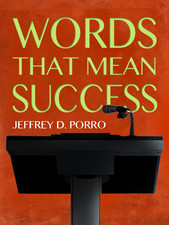 The latest book in our spotlight is Words That Mean Success by veteran speechwriter Jeff Porro. Building on his extensive experience writing for Fortune 250 CEOs, government leaders, and the like, Porro packs a lot of wisdom into this short book.
Words That Mean Success underscores the importance of the spoken word in business and gives sage advice on how to improve public speaking and better engage audiences. And by gathering lessons from top CEO communicators like Warren Buffet and Steve Jobs, Porro shows the real-world benefits of being a great speaker.
GG: What made you decide to write this book?
JP: I’d been thinking for a long time about updating and expanding some of my earlier writing on helping executives get the most out of the spoken word. But I have to admit that until recently, the thought of sitting down and doing a 200- or 300-page book was too daunting for me to even contemplate. Then I spoke with a friend who had just published a very successful business book, and he opened my eyes to an idea that now seems rather obvious: a lot of businesspeople are extremely busy and prefer books you can read in one sitting. I knew that was something I could write.
GG: Can you reveal a tip or two from the book?
JP: One is that the speechwriting process should start long before you put fingers on a keyboard. A good speechwriter begins by researching the venue, the audience, the speaker, and more. The other tip that may surprise people is that conflict is a good thing—at least in a speech. Lee Iacocca put it best when he wrote, “A good speech, like a good novel, is constructed around conflict.”
GG: How did you get started as a speechwriter?
JP: I became a freelance writer back in the 1990s, when the magazine where I was working let nearly the entire staff go at once. At first I did all kinds of writing and editing, then I narrowed my focus to what I call “promotional writing,” helping people and organizations get their messages out. I began to get bored with that, though, so I worked with an executive coach, Mitchell Groter, who helped me realize that speechwriting was really my strength.
GG: What attracts you to speechwriting?
JP: I think it’s the fact that a great speech is an artful combination of a diverse set of elements. You have to capture the personality of the speaker, convey a specific messages, target a particular audience, and so on. Plus you can use humor, history, quotes, current events—it’s an exciting challenge to bring it all together and make it work.
GG: Do you have a favorite speech you’ve written?
JP: There is one in particular where all the elements came together exactly the way they should. It was the commencement speech Anne Goddard, the head of ChildFund International, gave at her alma mater, Assumption College, in 2009. She is a terrific woman with a great sense of humor, and she was very willing to share wonderful stories. I’m very proud of that speech, but Anne made my job pretty easy.
GG: If you had to sum up what you do in one word, á la Dan Pink, what would it be?
JP: “Engage.” I help executives use speeches, talks, and presentation to engage their audiences.
Tuesday, April 2, 2013
Congrats to the 2013 Cicero Speechwriting Awards Winners!

Sarah Gray was the Grand Winner for "Lord, Please Let Me Provide for My Family: A Wounded Veteran's Story," a speech she wrote for veteran Neil Colomac. (Read the speech here.)
In addition, GG friends Hal Gordon, Nate Osburn, Paul Nuti, and John Barnes were honored at the event.
Gordon won in the technology category for "Getting to the Future Faster." Osburn's speech for the U.S. Commerce Secretary, "Make It in America," won in the economics category, and he also received an honorable mention for "A Path Forward for American Cars." Other honorable mentions included Nuti's "Convocation Keynote" and two energy sector speeches by Barnes, "The Energy Challenge" and "A Safer, Stronger BP: Our Quest to Earn Back America's Trust."
Click here (PDF) to see a full list of all the winners and to read their winning speeches.
Friday, March 29, 2013
Spring Writing Conferences

On April 5–7 is the Writer's Digest Conference East in New York City, covering a variety of topics related to writing and publishing. The first day is entirely devoted to self-publishing, everything from design and legal issues to agents and marketing. The rest of the weekend includes sessions like "Pitch Perfect," "Writing in the Digital Era," and "How to Become a Regular Contributor at Any Publication."
Ghostwriters Unite!, the first conference of its kind, will see ghosts from around the world gather in Long Beach, California, from May 3–5 to discuss everything from fee standards, ethical boundaries, problem clients, and bylines. Panel topics include "Finding Clients," "Negotiating Fees," and "Ghostwriting for Celebrities."
Speechwriters will gather in London from May 15–17 for the European Speechwriter Network Conference. The organization has invited a diverse group of speechwriters to speak about their work and the lessons they've learned. Topics of discussion will include how to write for international audiences and whether writing for men and women is different.
It's almost time for the annual BookExpo America, which will be held May 30–June 1 at the Javits Center in New York City. The massive three-day trade fair will showcase booths and exhibits by all the major and minor book publishers from the U.S. and abroad. There will also be breakout sessions on variety of industry topics, including "uPublishu at BEA" on self-publishing, "BEA Bloggers Conference," and many, many more.
Friday, March 8, 2013
Why a CEO Should Never Deliver a TED-Style Talk
By David Murray
CEOs don’t want to look too polished, because they think they’ll be branded as shallow.
A speechwriter friend of mine at a Fortune 100 company complained that CEOs all recognize that the TED Talk is The Way to Communicate. But then they refuse to do TED-style delivery. He recognized that part of the reason is because TED Talks take a ton of time and energy to prepare for.
“Practice when you feel like it,” advises recent TED Talker Nilofer Merchant.
Now, what CEO is going to sweat a speech like that?
But a more fundamental problem is: What CEO wants to be thought of—by investors, employees and maybe most importantly, by CEO peers—as someone so focused on public performance? And thus not focused on analysis, deal-making and decision-making that we expect CEOs to be thoroughly absorbed in at all times?
And that self-conscious CEO has a point. Aside from Steve Jobs, whose performances we saw as the spearhead of the company’s new product sales, wouldn’t you harbor some suspicion about the vanity and greater ambition of a CEO who delivered a perfect TED Talk?
Not that there isn’t a mile of middle ground between TED perfection and the typical CEO speech. And not that TED Talks don’t model many of the tools—economy, focus, storytelling, personalization—that we urge our clients to use. But if TED is actually not the ideal in executive communication, then let’s not punish ourselves and our clients by pretending it is.
David Murray, who has covered speechwriting and executive communication for nearly two decades, is editor of Vital Speeches of the Day. This post originally appeared on the VSOTD blog.
CEOs don’t want to look too polished, because they think they’ll be branded as shallow.
A speechwriter friend of mine at a Fortune 100 company complained that CEOs all recognize that the TED Talk is The Way to Communicate. But then they refuse to do TED-style delivery. He recognized that part of the reason is because TED Talks take a ton of time and energy to prepare for.
“Practice when you feel like it,” advises recent TED Talker Nilofer Merchant.
And, even when you don’t feel like it. At least two weeks out from a big talk, start to deliver the talk with notes and ultimately without them. Memorize where possible. I say it to myself 15 minutes every day. And once right before bed. Then I get a full night of restful sleep so that some part of my brain commits it to memory. At one week out, I’ve moved to keywords on Post-it notes. By five days out, I am no longer looking at any notes. I usually wake up the full week before a talk with it playing in my mind. You want it in there, even though it won’t actually be the talk that’ll come out that day. There is the talk you plan on giving and the talk that you give. If you are great at performance and memorization, it’s quite possible for those to be one and the same. But the more important thing to happen is for you to know what you came to say and know it well.
Now, what CEO is going to sweat a speech like that?
But a more fundamental problem is: What CEO wants to be thought of—by investors, employees and maybe most importantly, by CEO peers—as someone so focused on public performance? And thus not focused on analysis, deal-making and decision-making that we expect CEOs to be thoroughly absorbed in at all times?
And that self-conscious CEO has a point. Aside from Steve Jobs, whose performances we saw as the spearhead of the company’s new product sales, wouldn’t you harbor some suspicion about the vanity and greater ambition of a CEO who delivered a perfect TED Talk?
Not that there isn’t a mile of middle ground between TED perfection and the typical CEO speech. And not that TED Talks don’t model many of the tools—economy, focus, storytelling, personalization—that we urge our clients to use. But if TED is actually not the ideal in executive communication, then let’s not punish ourselves and our clients by pretending it is.
David Murray, who has covered speechwriting and executive communication for nearly two decades, is editor of Vital Speeches of the Day. This post originally appeared on the VSOTD blog.
Friday, January 18, 2013
Guest Post: What Leaders Need: A Confident Confidant
By Ian Griffin
 Seven years ago this month, I started the Professionally Speaking blog. Now I’ve reached the milestone of 700 blog postings. This seems like a suitable moment to reflect on some of the key lessons I’ve learned from my experience in providing executive communications support to my clients in Silicon Valley and around the world. You know you’ve hired a world-class speechwriter and communications consultant when they embrace these seven qualities.
1: CEOs need a confident confidant
Sitting in meetings at major Silicon Valley companies such as Sun Microsystems, Hewlett-Packard and Cisco, I’m often the only person in the room without a few thousand people reporting to them or a multi-billion-dollar target to meet. This can be an incredibly useful role that a CEO will come to value. As the speechwriter, I’m the one person in the room the CEO can turn to without an agenda of my own to advance. A CEO once told me, “Ian, it’s lonely at the top. I’ve seen every scam that managers can pull to cover their rear ends. I need someone like you who can tell it like it is.”
Key Lesson: Speechwriters with the confidence to speak up become the confidant and trusted adviser of a senior executive.
2: Be an impartial observer
I was brought in to edit an annual report for a European client with four separate divisions. My role was to resolve the different viewpoints of each group. The VP of Communications needed an outside consultant with the independence required to be able to write a cohesive document. Executive communications professionals are in a unique position to be an impartial observer in large organizations with multiple departments and competing interests.
Key Lesson: Take the initiative and tell the truth, no matter what certain executives want to hear. But don’t take sides within a company. We need to keep lines of communication open to all parties.
3: Take complexity out
Companies are filled with subject matter experts (SMEs) in engineering, finance, marketing, and sales. A speechwriter is a jack-of-all-trades, master of none. That’s our hidden value to a company. It’s my job to know a little bit about everything the company does, and then to know who to ask for answers when I need details. But lack of detail is rarely an issue. Time and again, I’ve asked SMEs for the background needed for 5-10 minutes of a speech only to be given enough data for a two-day seminar. My job is to absorb enormous volumes of data and take the complexity out; to find a way to communicate the message without putting the audience to sleep.
Key Lesson: Learn to simplify. Only include what is necessary to convey what is essential. As Einstein said, “Everything should be made as simple as possible, but not simpler.”
4: Tell compelling stories
As has been noted by others, people may not remember what you did or said but they will always remember how you made them feel. Audiences forget facts but they remember stories. Once you get past the jargon, the corporate world is an endless source of fascinating stories. I’ve found the best source of great stories for speeches come from informal chats when you are sitting down over coffee or, as I did one memorable afternoon, sharing a beer and pizza with the CEO in Boston’s North End. We talked about our time there as students. He shared a story about the lessons he’d learned outside the Harvard classroom that I used in a future speech.
Key Lesson: Always listen for stories executives tell about their childhood, family life, hobbies, early career and more. Dig for specifics. As speech coach Patricia Fripp says: “Specificity builds credibility.”
5: Embrace multimedia
The one-hour keynote is an endangered species. Conference organizers know audiences have short attention spans. Given travel budget restrictions, many organizations are turning to virtual meetings. Executives now need to feel comfortable on camera as well as on the podium. My three years as a communications consultant at Cisco introduced me to the exciting possibilities of TelePresence meetings. I also enjoyed access to fully-equipped TV studios to produce All Hands meetings. But it was just as exciting working with the limitations of a simple Flip camera, capturing video which I edited with Windows Movie Maker. These days it’s not just enough to write clever speeches, you need to keep current with the latest in multimedia technology.
Key Lesson: Digital media expands the boundaries of executive communications. Suggest it as an alternative to travel; use it to time-shift; create content that includes outdoor shots, audience testimonials and impromptu out-takes; record staff interviews; livestream events; experiment with transmedia storytelling.
6: Open up the backchannel
The audience is no longer silent. They might look like they are sitting quietly, but a raging debate on what Cliff Atkinson called The Backchannel can occur within and beyond the confines of the presentation venue. I’m amazed at the resistance some speakers have to this. My experience curating Twitter hashtags for specific events shows that there’s a rapidly emerging opportunity to magnify the impact of a speech and increase the reach beyond the walls of the auditorium.
Key Lesson: Learn about and embrace the backchannel. Make sure your executive has a Twitter account and use it for shameless self-promotion and to stimulate a lively debate before, during and after each presentation they make.
7: Learn to ask the right questions
As a communications professional, it’s not your role to out-gun the SMEs, VPs and assorted executives in the C-Suite when it comes to content. Our role is to ask what headline the CEO wants the speech to generate. To find out the audience’s hot buttons. To uncover the unique point of view the speaker brings to the issue. If there’s one lesson I’ve taken away from the work I’ve done for clients, it’s to always be ready to ask “Why is that?” when they suggest a point they want to make in a speech. Then, when they give an answer, having the courage to ask the same question again. It’s often only after they answer for the third time that the core of the speech is revealed.
Key Lesson: Don’t hurry to get to a final draft. Be professional and respect deadlines, but keep asking questions until you reach an answer that will make the audience sit up and take notice.
What executive communications lessons have you learned?
Ian Griffin is a veteran speechwriter and blogger at Professionally Speaking who helps high-level executives craft their communications. He previously worked in the corporate communications departments at Cisco, Hewlett-Packard, and Sun Microsystems and has over twenty years of speechwriting experience.
Ian Griffin is a veteran speechwriter and blogger at Professionally Speaking who helps high-level executives craft their communications. He previously worked in the corporate communications departments at Cisco, Hewlett-Packard, and Sun Microsystems and has over twenty years of speechwriting experience.
Monday, July 16, 2012
When It Comes to Speechwriting, "I'll Have What She's Having."
Nora Ephron, who, sadly, passed away June 26th, was not only a great writer of romantic dialogue; she was also terrific at penning her own lines. There have been many tributes to the "Queen of Quips" over the past few weeks most focusing on her screenplays (especially When Harry Met Sally, her most famous work) and books. But one of the greatest testaments to Ephron's skill as a writer and communicator was her 1996 commencement address at Wellesley College.
Many people erroneously assume that any good writer can write a good speech. But as those of us in the field intimately understand, putting together a pitch-perfect speech is a very specific art. Terrific speechwriting blog The Eloquent Woman posted a great piece analyzing what made Ephron's remarks so effective, reminding us that the best speeches are those that a) tell a story, b) use plenty of detail, and c) make the audience laugh.
Many people erroneously assume that any good writer can write a good speech. But as those of us in the field intimately understand, putting together a pitch-perfect speech is a very specific art. Terrific speechwriting blog The Eloquent Woman posted a great piece analyzing what made Ephron's remarks so effective, reminding us that the best speeches are those that a) tell a story, b) use plenty of detail, and c) make the audience laugh.
Friday, July 6, 2012
Around the Word
Ready, Set, Read. Only have five minutes while you wait for the next train to come? Ten minutes as you wait for your significant other to finish getting ready? A trio of Dutch publishers have released the Delay App, which lets readers enter how much time they have and then spits out a selection of stories and novel excerpts that can be read in said timeframe. The selections are a mix between classic and modern, and the app has become extremely popular, introducing readers to a variety of writing they might not have seen otherwise.
To My Speechwriter, With Love. Over at Vital Speeches of the Day, David Murray has a moving piece about JFK's speechwriter Ted Sorenson, and the incredibly strong bond he had with the president. The same love is being shown for “Chelsea punk” turned political speechwriter Joe Resnek, who went from stealing candy to writing speeches for White House chiefs of staff, thanks to his dedication and headstrong attitude. He’s even become a regular at the 1600 Pennsylvania Avenue basketball court.
The eBible. Starting July 16, the Hotel Indigo in Newcastle, England, will replace all 148 nightstand copies of the Bible with a Kindle—one that has the good book already downloaded. Any other religious book can be downloaded on the house, but commercial novels will be charged to the guest’s bill. You’ll have to read fast, because the books you download will stay with the Kindle when you check out.
A Desk With a View. Janet Groth, who worked as a receptionist on the eighteenth floor of The New Yorker for twenty-one years, has published a memoir: The Receptionist: An Education at The New Yorker. The tell-all details all her years spent with a bird’s-eye view of the office, a few sordid affairs with some of the magazine’s contributors, and why she never made the jump from secretary to writer. Although at times she certainly felt mistreated, the perks definitely made up for it. As Groth says, “It is not clear to me who was exploiting whom.”
To My Speechwriter, With Love. Over at Vital Speeches of the Day, David Murray has a moving piece about JFK's speechwriter Ted Sorenson, and the incredibly strong bond he had with the president. The same love is being shown for “Chelsea punk” turned political speechwriter Joe Resnek, who went from stealing candy to writing speeches for White House chiefs of staff, thanks to his dedication and headstrong attitude. He’s even become a regular at the 1600 Pennsylvania Avenue basketball court.
The eBible. Starting July 16, the Hotel Indigo in Newcastle, England, will replace all 148 nightstand copies of the Bible with a Kindle—one that has the good book already downloaded. Any other religious book can be downloaded on the house, but commercial novels will be charged to the guest’s bill. You’ll have to read fast, because the books you download will stay with the Kindle when you check out.
A Desk With a View. Janet Groth, who worked as a receptionist on the eighteenth floor of The New Yorker for twenty-one years, has published a memoir: The Receptionist: An Education at The New Yorker. The tell-all details all her years spent with a bird’s-eye view of the office, a few sordid affairs with some of the magazine’s contributors, and why she never made the jump from secretary to writer. Although at times she certainly felt mistreated, the perks definitely made up for it. As Groth says, “It is not clear to me who was exploiting whom.”
Thursday, July 5, 2012
Gotham Featured on Contently's "Freelance Strategist"
Gotham was recently featured on publishing and media site Contently, in an article entitled "Diversify and Increase Your Income with Ghostwriting." Reinforcing a point we often like to make, the article, which was written for their "Freelance Strategist" blog, illuminates the idea that ghostwriting is
no longer the domain of celebrity vanity, but has evolved into an
increasingly key piece of many corporate communications and thought-leadership strategies—making it a great opportunity for freelancer writers. From speechwriting to white papers, from big-think pieces to smart blog posts, many businesses are realizing that hiring freelancers is
a time-saving and cost-effective way to improve brand positioning and
awareness. Says GG President Dan Gerstein in the piece, "On one hand, there are shrinking opportunities in the journalism field,
but the flip side is that there are growing opportunities to get paid
for what are increasingly in-demand skills... Ghostwriting collectives are a way to diversify your
business and get access to opportunities you wouldn’t have otherwise."
Friday, April 20, 2012
Money for Nothing (And Your Speech for Free)
We know as well as anyone that speechwriting has been traditionally undervalued in the marketplace, but a new service, brought to our attention by Vital Speeches guru David Murray, has literally taken it to a new low. Speeches4less claims they'll write your entire speech in 5 days and only charge you $5 per 500 words.
David Murray went right to the source, and penned a two-part article (here and here) on the company, explaining why what they're doing isn't just bad for speechwriters, it's bad for everyone. This is a must-read for our friends in the speechwriting community. "Speechwriting isn’t expensive because clients are stupid enough to pay. It’s expensive because it (ostensibly) involves talented writers spending real time getting to know clients who really want to communicate something specific to a particular group of people." Hear, hear!
 |
| art from clipartheaven |
Thursday, March 15, 2012
Babble Bubble Trouble

One of our favorite word-nerd articles of the year was the recent New York Magazine cover story about what was cutely referred to as the “babble bubble”—the explosion of big-think, TED-like conferences and the mass speechifying they have spawned. What was most interesting to us was the big-think questions the piece spawned: Is this bubble likely to pop relatively soon, as writer Benjamin Wallace suggests, a fad to soon fade away? Or are these fabulous confabs looking like an enduring fixture?
To get some expert perspective, we asked some of our speechwriting pros about the implications for our industry, and unsurprisingly, their opinions led in many different directions.
James Buchanan, a business journalist, writer, and editor, is in favor of anything that encourages intellectual rigor and affords us the time to contemplate new ideas. “In the modern digital world, communication and data/information sharing happens so fast that we barely have time to think about the implications of what we hear. TED and others provide a moment of time and clarity where we can hear what others think, they can explain their insights and the implications of those insights, and we can develop our own opinions. As a writer, this can only be of help. Ideas spark books, which spark ideas, which spark books, and on and on.”
On the other hand, Michael Gural-Maiello, an accomplished business writer who writes regularly for Forbes, comes in on the other side of the fence. “The undoing of these people is their unapologetic elitism; look at the pathetic complaints about all of the ‘betas’ being let into the room. I think the saddest observation [in the article] was that the TED Talk has replaced the book as the ultimate ambition for somebody who wants to express themselves. That's certainly evidence that we've lost site of the breadth and scope of human experience. Or maybe it's just easier to talk for 18 minutes than it is to write 300 coherent pages.”
In the middle we have Assaf Kedem, an award-winning speechwriter and communications strategist, who takes a historical view of these conferences. “Confabs have been around for longer than one may realize. Their modern-day version, in some respects, is a reincarnation of the historical town meetings that date back to previous centuries. Today’s ‘fabulous confab’ is more exclusive, glamorous, and intellectually specialized. But whatever form it takes, the essential confab is here to stay so long as there is a marketplace of ideas to be exchanged.”
As the Millions noted yesterday, it’s suddenly fashionable to hate on TED. But hating is still discussing, and as long as we’re doing that, we don’t think the reign of the “babble bubble” is likely to wind down anytime soon.
To get some expert perspective, we asked some of our speechwriting pros about the implications for our industry, and unsurprisingly, their opinions led in many different directions.
James Buchanan, a business journalist, writer, and editor, is in favor of anything that encourages intellectual rigor and affords us the time to contemplate new ideas. “In the modern digital world, communication and data/information sharing happens so fast that we barely have time to think about the implications of what we hear. TED and others provide a moment of time and clarity where we can hear what others think, they can explain their insights and the implications of those insights, and we can develop our own opinions. As a writer, this can only be of help. Ideas spark books, which spark ideas, which spark books, and on and on.”
On the other hand, Michael Gural-Maiello, an accomplished business writer who writes regularly for Forbes, comes in on the other side of the fence. “The undoing of these people is their unapologetic elitism; look at the pathetic complaints about all of the ‘betas’ being let into the room. I think the saddest observation [in the article] was that the TED Talk has replaced the book as the ultimate ambition for somebody who wants to express themselves. That's certainly evidence that we've lost site of the breadth and scope of human experience. Or maybe it's just easier to talk for 18 minutes than it is to write 300 coherent pages.”
In the middle we have Assaf Kedem, an award-winning speechwriter and communications strategist, who takes a historical view of these conferences. “Confabs have been around for longer than one may realize. Their modern-day version, in some respects, is a reincarnation of the historical town meetings that date back to previous centuries. Today’s ‘fabulous confab’ is more exclusive, glamorous, and intellectually specialized. But whatever form it takes, the essential confab is here to stay so long as there is a marketplace of ideas to be exchanged.”
As the Millions noted yesterday, it’s suddenly fashionable to hate on TED. But hating is still discussing, and as long as we’re doing that, we don’t think the reign of the “babble bubble” is likely to wind down anytime soon.
Subscribe to:
Posts (Atom)
© 2008 Gotham Ghostwriters, All rights reserved.

 Posts
Posts


