Showing posts with label Alan goldsher. Show all posts

Friday, May 17, 2013

Tips for a Great Writer Website

We've all heard it said: first impressions are everything. This doesn't just apply to face-to-face interactions anymore; in our digital age, often the first "meeting happens online, so making sure you have a great professional website is an important part of building your reputation, both online and off. And for freelancers wanting to grow their client base, a great site can be the thing that sets you apart from the crowd.

Digital first impressions happen quickly. An article on Ragan covered the Missouri University of Science and Technology's research on the topic, and the results might surprise you: the study found that people form first impressions of a website within 2.6 seconds.

Knowing that the look and feel of a website can be what stands between someone reading your content—and potentially hiring you for a gig—or not, we looked at some great writer websites and broke down three essential components: professional appearance, simple layout, and well-organized samples.

Professional Appearance: 
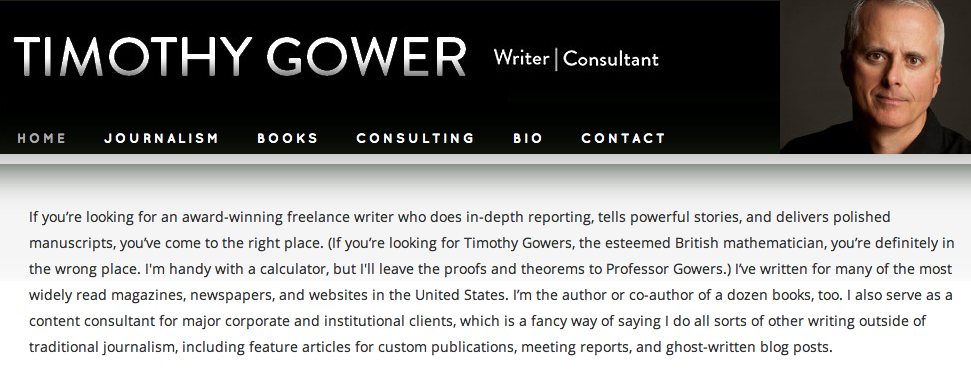
With less than 3 seconds to leave visitors with a positive impression, the overall look of your site should be very professional—avoid pictures of cats, overly "playful" fonts, and anything that could be construed as amateur. Timothy Gower and Cynthia Starks accomplish this well: their sites are simple, uncluttered, and use classic color schemes and fonts. The results are great-looking, professional websites that allows each writer and his or her content to stand out.


Simple Layout: 
Attention spans are shrinking by the minute, and people often don't have the patience to hunt for information, so it's very important to make clear who you are and what you do. Theresa Sullivan Barger and Alan Goldsher do a nice job of this: you have a clear sense of their skills and focus immediately, without having to scroll or click a link. Each also includes a professional photo, a brief bio, and clear tabs leading you to things like testimonials, projects, and contact information.


Although it may be tempting to include graphics, music, and other flourishes, resist the urge, as these are a distraction to your audience. Keep things simple and clear, and allow your work to speak for itself.


Well-Organized Samples:
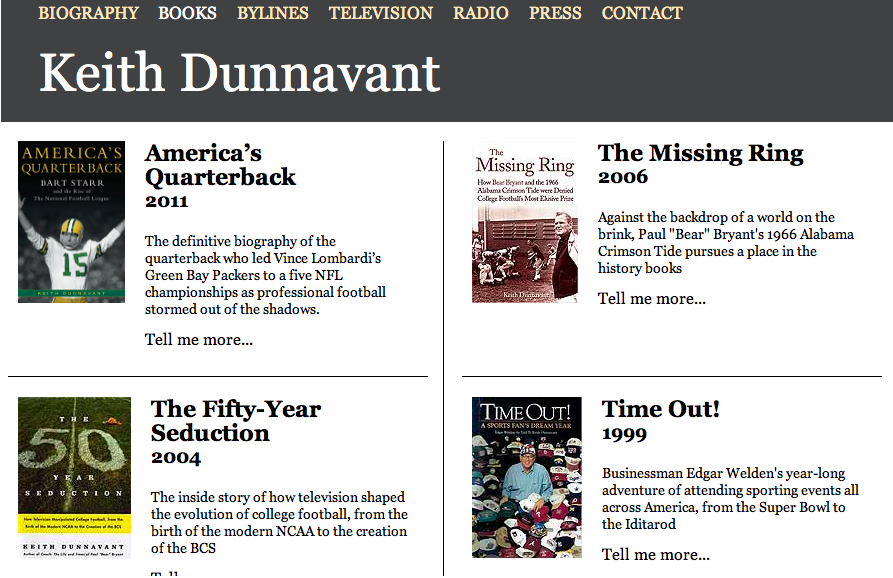
On freelance writer websites, samples are generally the main thing people want to see, so these should be easy to find and organized well. Whether you group your samples by topic or by project type, the best websites make it effortless to find and peruse your writing. Keith Dunnavant organizes his books chronologically and uses their cover images, which makes his credits both easy to follow and visually appealing.


Janice Harper also takes a simple approach, listing her samples by type and date.


Len Hollie, on the other hand, provides links to all of his samples and organizes them by topic, which lets viewers easily narrow their search.


Each writer has taken a unique approach suited their experience, but each site is well organized and easy to navigate.


These tips should not be one-size-fits-all solutions. Your website should reflect your personal style as well as who you are as a writer, which will be different for everyone. But by having a simple, professional, and well-organized website, you and your content will leave a great lasting impression.

Wednesday, December 14, 2011

Writer Profile: Alan Goldsher

Our regular look at the amazing writers we know.

One of the most flexible, diverse writers on the publishing landscape, Alan Goldsher is at home in any genre, in any style. Whether it's a horror novel, a romantic comedy, a comedic memoir, or a poignant autobiography, Alan can bring any book project to life. He is the author of the acclaimed remix novel Paul Is Undead: The British Zombie Invasion, as well as several forthcoming titles (four lined up for 2012!), including Give Death a Chance: The British Zombie Invasion 2, My Favorite Fangs: The Story of the von Trapp Family VampiresHow I Slept My Way to the Middle: Stories and Secrets from the Stage, the Screen, and the Interwebs (in collaboration with comedian/actor Kevin Pollak), and Miles Davis FAQ. He has written nine other books, including Hard Bop Academy: The Sidemen of Art Blakey and the Jazz Messengers, Midnight Movie (with director Tobe Hooper), Modest Mouse: A Pretty Good ReadThe True Naomi Story, and No Ordinary Girl. As a ghostwriter, Alan has collaborated on projects with dozens of notable celebrities and public figures. Prior to taking the writing world by storm, Alan spent 10+ years as a professional bassist, during which time he recorded with Janet Jackson, Cypress Hill, and Naughty by Nature; toured the world with Digable Planets; and performed at the 1994 Grammy Awards.

GG: What led you to become a ghostwriter?
AG: I'm a storyteller, and if I can help a non-writer tell their story—be it a memoir, a novel, some narrative non-fiction, whatever—that's a beautiful thing. Also, there's something to be said for writing as part of a team. Writing is a solitary profession (fiction, especially), so being part of a group-think is a nice change of pace.

What's the most unusual writing project you've done?
I can only pick one? Hmm. I helped a Haitian doctor write his memoir, but he wouldn't tell his full story because he was afraid that Papa Doc's family might track him down and murder him. He was a lovely man, but a little nervous. And then there was the angry, angry stand-up comic who... Well, we'll go over that one another time.

What's the most difficult part of being a full-time writer?
I like to juggle multiple projects, and sometimes folks don't get that. Often, a publishing industry type will ask me, "Are you really taking on another book?" I like to have several thing on my plate, and convincing the world at large that I can handle it, and handle it well (I think) can be frustrating. But it generally works out in the end, so it's all good. (Oh, and getting paid on a timely basis can be a pain in the pooper.)

What kinds of books do you like to read?
I'm all over the map, but if you had to pick a common thread, I guess you'd have to say I'm a pop-culture dude. Hip memoirs, sports books, film books, cool fiction, horror, that sort of thing.

Where can I find out more about you?
On my websiteFacebook, or Twitter.