Showing posts with label Ragan. Show all posts

Tuesday, January 20, 2015

Guest Post: Speechwriting never goes out of style


by David Murray

Tonight's the State of the Union Address, and today is the one day of the year when professional speechwriters emerge into the sunlight of cable news punditry, to bask for a day in their own importance as shapers of policy, articulators of arguments and supporters of leaders. And everyone vaguely wonders, "What kind of people are these, anyway?"

Today I'm here to answer that question, perhaps as authoritatively as it's ever been answered, with the results of the first survey of the global speechwriting profession.

First, I should say: I go back with these people. The very first business conference I ever attended in my first job out of college was a conference of speechwriters. I was assigned to work in the cloakroom.

So now, as the founder and executive director of the Professional Speechwriters Association, I can reliably interpret the findings of our first membership survey (co-conducted with Gotham Ghostwriters): Although the set and costumes have been rearranged—speechwriters no longer smoke pipes, nor research their speeches by leafing through quotation books, nor wear cloaks—the players remain and the script is unchanged.

See for yourself. According to the PSA survey:

• Speechwriters are older than their colleagues in public relations, more likely to be male, better educated—and better paid. 
The typical speechwriter is a 51-year-old man with a master's degree. More than half of the speechwriters surveyed make more than $100K, with 23 percent pulling in more than $150K (and half of those making over $200K).

• Speechwriters found their way into their work through serendipity.
Some speechwriters claimed a method to their professional madness, with one saying he joined the business "to fuse my love of writing with my love of policy/politics."

In a more typical answer to the question, "Why did you become a speechwriter in the first place?" one PSA member wrote that he "stumbled into the job—CEO needed a speech."

• Speechwriters love their work, and hate their work.
Asked what they like most about speechwriting, speechwriters said, "shaping public debates," "finding and telling stories," "intellectual and creative challenge and reward," "the variety of topics and amazing people that I get to work with," and "the silent hours when I through writing try to understand and share something important."

What do speechwriters like least about the job? Solitude, short deadlines, slow workflow, lawyers, leaders' indifference. Speechwriters resent clients who "don't care about content" and bureaucrats who care too much.

"I have to contend with constant micro-managing by people who see risk lurking in every corner and are afraid of letting the CEO take any kind of position," one speechwriter said. "They also have no feel for what constitutes good writing yet exert a huge influence over the process."

• Speechwriters fear for the future… 
Speechwriters feel threatened by new challenges, such as the increasing use of the Q-and-A format and other informal presentation techniques to replace formal speeches. And they face timeless ones, such as quantifying the strategic value of their work and "the everlasting suspicion of rhetoric."

• …and speechwriters envision a brighter future. 
Now that they're getting organized for the first time in a global association, they have very specific requests of their new Professional Speechwriters Association: They told us they don't want another rigid structure in their lives, nor an elaborate guild or union, but straight-up professional development and an expanded network through online and in-person networking programs.

Speechwriters are a joy and a pleasure to serve, because they're the most erudite, intense, joyful people in the communication profession. They're also the most frustrated. Now that they have a platform to organize, I hope they'll realize their potential as powerful actors in their organizations and in society.

Yes, I go back with these people. Now we'll go forward together.

David Murray is executive director of the Professional Speechwriters Association. He's also editor of Vital Speeches of the Day magazine.

Monday, March 10, 2014

Learning Off the Job by David Murray

This post originally appeared on Vital Speeches of the Day.

Just back from the Ragan Speechwriters and Executive Communicators Conference in Washington, where 180 full-time, part-time, or would-be speechwriters gathered to express indignation to one another and to the leading lights in the field, about how their speakers aren’t pulling their weight.

Oh, that’s not the only reason they came. They attended sessions and led bull sessions of their own, about the need for storytelling in speeches, the desirability of injecting authentic emotion and intellect into speeches, and they even called for their leaders to allow themselves to connect with audiences by being vulnerable.

But mostly, it was about their lack of access to the speaker and their speaker's unwillingness to participate in the speech-creation process. While everybody ought to have the right once a year to cry in their beer about how dumb the bosses are, this year—22 years after attending my first Ragan speechwriting show—I feel compelled to call bullshit.

Not that I disagree for a moment with speechwriters’ lament: that the CEOs, university presidents, and nonprofit directors who employ most speechwriters refuse to contribute more than a quarter of the thinking, work and time that would be required to create meaningful and memorable oral interactions with the audiences before they appear.

Speechwriters are dead right: Many leaders, as the warm, witty, and earnest former President Obama chief speechwriter Jon Favreau put it here, have no inkling about what they want to say—only an idea of the flattering light in which they want the audience to regard them afterward.

President Obama thinks it is worth his time to agonize over the ideas and the words in the speeches he gives, Favreau said. So if the leader of the free world feels that way, Favreau reasoned to this receptive crowd, then leaders of lesser institutions—the people he’s working for now as he runs his own firm, Fenway Strategies—should certainly deign to collaborate with their speechwriter too.

Here, young Favs betrayed the naivete he honestly earned by spending his whole twenties writing for a politician much more like himself than like any of the Fortune 500 CEOs and other public sector clients who are flocking to him now.

Why do CEOs want to hire Favreau? Is it because they remember those great speeches President Obama delivered after losing in New Hampshire, after winning in Chicago, on his historic trip to Cairo? And because they think that the wunderkind who wrote those persuasive speeches will help them convince their constituencies that yes, they also can?

Speechwriter, please.

These folks want Favreau because Favreau is—as I introduced him in my role as conference emcee—the Jennifer Lawrence of the speechwriting business.

A corporate leader who can abide a Democratic scribe and who wants everyone to know he or she has hired the best—this leader has only one choice in a speechwriter: Jon Favreau, the one and only It Boy.

I say none of this to disparage him. As I said on a conference call from the Mayflower, I think Jon Favreau is as fine a representative of this profession as I’ve ever met. He’s humble, he’s smart, he’s sincerely committed to the ideas his rhetoric has attempted to advance—and despite his young years, he’s probably as skilled a speechwriter as anyone else in the Mayflower Hotel ballroom last week.

It’s just that this isn’t why he’s got more clients than he wants—just as your professional skills and deficiencies have little to do with why your clients leave you to invent their ideas out of whole cloth, refuse to help you put their stamp on them and then read them for the first time in the Town Car on the way to the event. (Imagine the opposite scenario: Bill Maher telling his writers he doesn't have time to look at their jokes, he's sure they're fine, just plug 'em into the teleprompter and he'll read them when he walks out on stage.... No, you know he's all up in their faces all week long, rejecting this joke for being too obvious, rejecting that one for not being obvious enough, accepting this joke but honing it for half a day until his writers are ready to scream.)

It’s not that your leaders don’t believe in you. It’s that they don’t believe in speeches. Unlike politicians and comics, your leaders do not believe that words will help them achieve their goals.

Judging beliefs by actions, we must already know that our leaders believe their time and money is much better spent speaking with their lieutenants, mobilizing their lobbyists, and cultivating analysts and donors to raise money to grow their organizations and thus their power.

Speeches? By and large, they see these as symbolic events where they flatter the audience by showing up… where they sound intelligent and look confident… before returning home having taken one for the team and done nothing to undermine their real power: the size, the visibility and the prestige of the organization they lead.

Ideas? Stories? Authenticity? Vulnerability? These are things that speechwriters talk about (and talked about ad infinitum at the Ragan show). Power is the only thing that most leaders know.

So the challenge we face is bigger than we think. It’s not merely to convince our bosses that a speech will be improved by spending 15 minutes with you on the front end, exchanging a few emails with you during the writing, and rehearsing the speech once or twice before the audience hears it.

The challenge is to convince your leaders of something much more fundamental: that it is possible to find or to gather a group of human beings either so important or so large that telling them the truth as compellingly as possible can change the course of their organization—and their own career—for the better. (And without unduly risking the opposite result.)

Feverish speechwriter, chances are that whether you’re Joe Blow or Jon Favreau, your client doesn’t believe that right now.

How will you convince her?

I’ll be back with some ideas next week. But I’d like to read yours in the meantime. —DM

Friday, May 17, 2013

Tips for a Great Writer Website

We've all heard it said: first impressions are everything. This doesn't just apply to face-to-face interactions anymore; in our digital age, often the first "meeting happens online, so making sure you have a great professional website is an important part of building your reputation, both online and off. And for freelancers wanting to grow their client base, a great site can be the thing that sets you apart from the crowd.

Digital first impressions happen quickly. An article on Ragan covered the Missouri University of Science and Technology's research on the topic, and the results might surprise you: the study found that people form first impressions of a website within 2.6 seconds.

Knowing that the look and feel of a website can be what stands between someone reading your content—and potentially hiring you for a gig—or not, we looked at some great writer websites and broke down three essential components: professional appearance, simple layout, and well-organized samples.

Professional Appearance: 
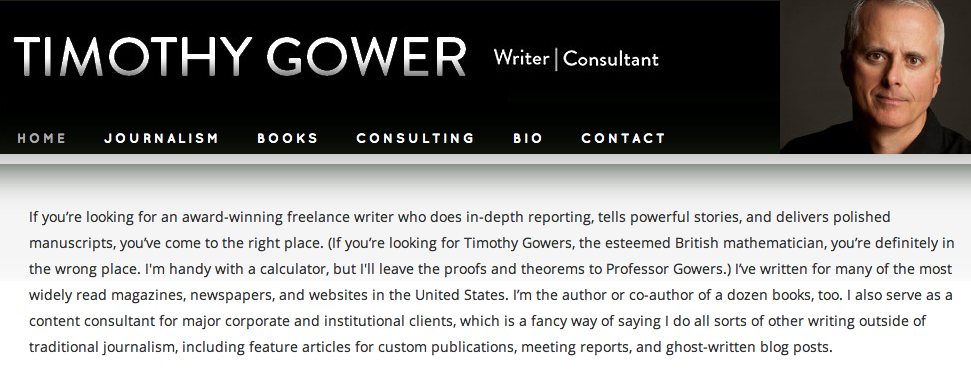
With less than 3 seconds to leave visitors with a positive impression, the overall look of your site should be very professional—avoid pictures of cats, overly "playful" fonts, and anything that could be construed as amateur. Timothy Gower and Cynthia Starks accomplish this well: their sites are simple, uncluttered, and use classic color schemes and fonts. The results are great-looking, professional websites that allows each writer and his or her content to stand out.


Simple Layout: 
Attention spans are shrinking by the minute, and people often don't have the patience to hunt for information, so it's very important to make clear who you are and what you do. Theresa Sullivan Barger and Alan Goldsher do a nice job of this: you have a clear sense of their skills and focus immediately, without having to scroll or click a link. Each also includes a professional photo, a brief bio, and clear tabs leading you to things like testimonials, projects, and contact information.


Although it may be tempting to include graphics, music, and other flourishes, resist the urge, as these are a distraction to your audience. Keep things simple and clear, and allow your work to speak for itself.


Well-Organized Samples:
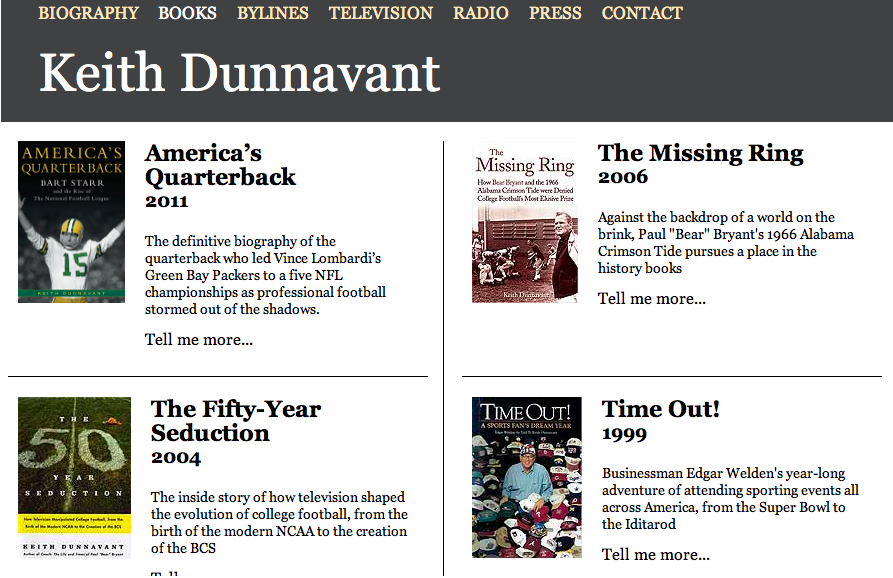
On freelance writer websites, samples are generally the main thing people want to see, so these should be easy to find and organized well. Whether you group your samples by topic or by project type, the best websites make it effortless to find and peruse your writing. Keith Dunnavant organizes his books chronologically and uses their cover images, which makes his credits both easy to follow and visually appealing.


Janice Harper also takes a simple approach, listing her samples by type and date.


Len Hollie, on the other hand, provides links to all of his samples and organizes them by topic, which lets viewers easily narrow their search.


Each writer has taken a unique approach suited their experience, but each site is well organized and easy to navigate.


These tips should not be one-size-fits-all solutions. Your website should reflect your personal style as well as who you are as a writer, which will be different for everyone. But by having a simple, professional, and well-organized website, you and your content will leave a great lasting impression.

Wednesday, January 25, 2012

10 Must-Have Books for Speechwriters

By Michael Long
This article first appeared on Ragan.

Those of us who write for a living know that most books on “how to write” are far more for the benefit of the author than the reader; that is, they are often make-a-buck hardbacks for resourceful authors, dangled before people who prefer to imagine the writer’s life than to indulge in its air-conditioned torment and capriciously timed paydays.
The few “writing” books I find worth my time offer unique supporting material not available on the Internet, and encourage me to think about my work from a new perspective. On that basis, here are ten or so titles that every speechwriter—every writer, actually—can learn from, and even enjoy.
The Elements of Style by William Strunk and E.B. White. This comes first because by comparison everything else is mere ornament. Strunk and White provide a lesson in clarity delivered with wit and brevity. You can’t read this and not become a better writer.
Lend Me Your Ears: Great Speeches in History by William Safire. This reference is a tour of styles in their eras, yet also a reminder that elements of persuasion and structure are as old as time. That points to the next title...
The Trivium: The Liberal Arts of Logic, Grammar, and Rhetoric by Sister Miriam Joseph. Speechwriting as a class or even a course of academic study is a recent phenomenon. Most of us who write speeches landed the job by insisting we could do it, not by studying technique. But speechwriting is in many ways nothing more than a sophisticated application of reasoning and expression. This dense and powerful book (which is enjoying a little renaissance just now) is a detailed tour of the function of language and communication, and the power of precision.
The Political Speechwriter’s Companion by Robert Lehrman. This 2010 textbook is by novelist and former Al Gore speechwriter (and Ragan presenter) Bob Lehrman, who will be giving a few talks at the March Speechwriter’s Conference in Washington, D.C. Forget the title. This is a clear, even joyful guide to the mechanics of all speechwriting, with some down-to-earth direction on wordsmithing on top of it all. Speaking of wordsmithing...
Tunesmith by Jimmy Webb. Essayist Jay Nordlinger quotes an old professor of his:  “You want to write better? See a ballet, listen to a symphony—get some art in you. Get some artistry in your prose.” Just so. Webb is among the most talented and successful songwriters of the last 60 years, and in this book he explains where his memorable turns of phrase come from—and he doesn’t prescribes simply waiting for the muse. Webb talks about poetry and prose in structural terms, and he attaches method to what most of us imagine to be only born-with-it inspiration.
Save the Cat by Blake Snyder. Here’s a book on screenwriting that breaks down modern drama into points of a story, all of which build on the classic idea of tension and release. Snyder’s lesson for speechwriters is that prose gains color and, therefore, power when it exploits dramatic tension. Snyder shows step by step how to create drama in general and tension in particular, among many other lessons that the creative speechwriter will use over and over again.
Speech is performance—a form of acting. Speechwriters who understand this can better balance detail with emotion and will put into proper perspective (and practice!) what ought to be at the center of the craft, which is its often-ignored theatrical aspects. The best mainstream guide to this idea is also a delight to read:  2010’s Theatre by David Mamet, arguably the world’s greatest living playwright. 
A few more to round out the list:  Any joke book on the remainder table at Barnes & Noble is worth your money, because simple jokes are always in demand, and the Internet will lead you to the same few chestnuts over and over. This Day in Business History by Raymond Francis is a splendid collection of anecdotes that are perfect for introducing or illustrating any topic, while Condemned to Repeat It by Wick Allison, Jeremy Adams and Gavin Hambly explores, in essay form, several dozen historical incidents as demonstrations of lessons in business and life.
Finally, Amusing Ourselves to Death by Neil Postman explains how the nature of communication is inseparable from its content. Written before the rise of the Internet, its psychological and sociological points are still true (and still disturbing) and important for all speechwriters to know.
A frequent presenter at Ragan conferences, Michael Long is a freelance writer and speechwriter in Washington, D.C., and an adjunct professor teaching writing and public relations at Georgetown University. His website is mikelongonline.com.

Wednesday, January 4, 2012

From Ragan: Bad Writing Is Killing America

If you work at a writing firm (or are given to perusing the blog of same), a headline like that is bound to catch your attention.

Over on Ragan, Mark Ragan has an interview with Peter Shankman, founder of Help a Reporter Out, who is just a little bit upset about the rampant bad writing in the media, especially in places like Twitter. He says: "Having an audience is a privilege, not a right. It's much like wearing spandex."

Check out the full interview below.


Tuesday, December 27, 2011

Best Language Moments of 2011, by Maslansky Luntz + Partners

As another year draws to a close, everyone's scrambling to put together their best "best of" list. Time has the 50 Best Websites, Publishers Weekly has the Best Books by category, Ragan has the 10 Best and Worst Communicators, Flavorpill has the Best Debut Novels, Huffington Post has the Best Commencement Speeches.

We could go on, of course, but we know you have New Year's Eve to plan. So instead we'll give you one more great best of, this one from GG friends maslansky luntz + partners, a terrific communications strategy firm. Say they:

"From entertainers Charlie Sheen and Hank Williams to President Obama and the always-entertaining GOP presidential field, here are our choices for the most memorable language moments of the year."

Monday, December 19, 2011

Around the Word

The best gift for a writer. For those of you who prize creative gifts that don't necessarily cost a lot, and especially for those having a Buy Nothing Christmas, GalleyCat has an excellent suggestion for the writer in your life: give the gift of time. Among other ideas, you can "let them borrow your office on the weekend...promise to babysit on a weekday evening...volunteer to do their household chores for a day...in short, do anything it takes to help your writer friend find a few consecutive hours of peace and quiet to write." In the article's comments, writers suggested a second (free) gift idea: read their book and give them a positive review on Amazon or another book site. Any other ideas for non-traditional gifts for writers? Tell us in the comments.

Winning words. PR Newswire revealed earlier this month that for the first time, Oxford English Dictionaries in both the US and the UK chose the same phrase for Word of the Year: "squeezed middle." Here at GG, we didn't think that was such a great pick. In contrast, this list from Flavorwire of the Most Memorable Words of the Year seems a lot more comprehensive, and includes some terrific ones, like "Arab Spring," "occupy," and "planking." Are there any words you think they forgot?

Losing words. Speaking of words of the year, Marist announced the results of their poll for the years most annoying word. We'll skip the suspense and tell you that for the third year in a row, the winner is "whatever," with "like," "you know," and "just sayin'" close behind. Do you agree?

Memorable closers. For those speech-givers and -writers out there, there are a lot of things to take into consideration when planning out a winning speech. You should of course consult our friend Fletcher Dean's terrific book 10 Steps to Writing a Vital Speech, and to supplement that, Ragan has a list of 5 great ways to close.

Monday, December 12, 2011

Book Spotlight: 10 Steps to Writing a Vital Speech by Fletcher Dean

We're doing another new feature here on the BloGG: book spotlights! Our inaugural title is 10 Steps to Writing a Vital Speech by Fletcher Dean, one of the most seasoned and successful speechwriters in the world. This detailed, comprehensive, definitive guide was published by Vital Speeches of the Day, the most respected brand in the field. It's a fantastically thorough resource, and of course would make a terrific gift for any public speaker or communications pro on your holiday shopping list. 

Gotham Ghostwriters asked Fletcher Dean a few questions about his speechwriting life and his writing process. 
How did you get your start as a speechwriter?
It was entirely unplanned. I was an English major who turned to journalism to make a living, then I traded that for a better-paying job in corporate America doing mostly internal communications work. They thought I was a good writer and offered me a chance to do speechwriting, a position I hadn't even known existed in the company. Obviously, that was a career-changer for me, and I’ve never really looked back. I've been speechwriting for almost twenty years.

Do you have a favorite speech you've written? 
One of my favorites was written for Earnie Deavenport, the former CEO of Eastman Chemical Company and true Southern gentleman. He was scheduled to give a speech in New York almost exactly a year after 9/11, just blocks away from Ground Zero. For many attendees, this was their first time in New York since 9/11, so terrorism was front and center in their thoughts. We used that mind-set to our advantage, crafting a speech titled “Terrorism Is Not Our Greatest Threat.” It captured attention from the very beginning because it begged the question: if not terrorism, what is our greatest threat? This was a rare case where the first words I wrote of the speech were the title.

Putting the mechanics of the speech aside, what makes up your routine when you sit down to write? 
I divide my process into several steps. Sometimes they overlap, but I make sure to hit all of these at some point and in this order: 
  • Learn as much as possible about the audience and its concerns. 
  • Learn as much as possible about the topic. 
  • Discover the common problem or concern. 
  • Determine what we want the audience to do or believe about that problem.
Once I've accomplished all of that, I begin to craft some key messages and put that into a format that engages the audience. Then I write. Then I edit. And re-edit and re-edit and re-edit some more. I edit more than I write. Sometimes I think the job should be called “speech editor” instead of “speechwriter.”

Your book is very comprehensive, but can you suggest any other resources for speechwriters or aspiring speechwriters?
The Internet has not only revolutionized the way speechwriters do their jobs but also the way they interact with and learn from one another. There are several good blogs out there—from Jeff Porro, Nick Morgan, and Vital Speeches, just to name a few—that showcase real writers doing real work. There are many, many more, and the Internet is facilitating the development of a real community of speechwriters. That’s the easy way to learn about the profession. Then think seriously about some training. I started going to the Ragan Speechwriters Conference years ago and highly recommended it. (Full disclosure: I’m speaking there again in 2012.) There are also some good speechwriting coaches out there, like Joan Detz in Philadelphia and Wendy Cherwinski in Ottawa. Finally, though it may seem cliché, you learn by doing. There is no better way to learn to write than by sitting down and writing.