
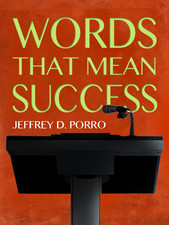
 The latest book in our spotlight is Words That Mean Success by veteran speechwriter Jeff Porro. Building on his extensive experience writing for Fortune 250 CEOs, government leaders, and the like, Porro packs a lot of wisdom into this short book.
Words That Mean Success underscores the importance of the spoken word in business and gives sage advice on how to improve public speaking and better engage audiences. And by gathering lessons from top CEO communicators like Warren Buffet and Steve Jobs, Porro shows the real-world benefits of being a great speaker.
GG: What made you decide to write this book?
JP: I’d been thinking for a long time about updating and expanding some of my earlier writing on helping executives get the most out of the spoken word. But I have to admit that until recently, the thought of sitting down and doing a 200- or 300-page book was too daunting for me to even contemplate. Then I spoke with a friend who had just published a very successful business book, and he opened my eyes to an idea that now seems rather obvious: a lot of businesspeople are extremely busy and prefer books you can read in one sitting. I knew that was something I could write.
GG: Can you reveal a tip or two from the book?
JP: One is that the speechwriting process should start long before you put fingers on a keyboard. A good speechwriter begins by researching the venue, the audience, the speaker, and more. The other tip that may surprise people is that conflict is a good thing—at least in a speech. Lee Iacocca put it best when he wrote, “A good speech, like a good novel, is constructed around conflict.”
GG: How did you get started as a speechwriter?
JP: I became a freelance writer back in the 1990s, when the magazine where I was working let nearly the entire staff go at once. At first I did all kinds of writing and editing, then I narrowed my focus to what I call “promotional writing,” helping people and organizations get their messages out. I began to get bored with that, though, so I worked with an executive coach, Mitchell Groter, who helped me realize that speechwriting was really my strength.
GG: What attracts you to speechwriting?
JP: I think it’s the fact that a great speech is an artful combination of a diverse set of elements. You have to capture the personality of the speaker, convey a specific messages, target a particular audience, and so on. Plus you can use humor, history, quotes, current events—it’s an exciting challenge to bring it all together and make it work.
GG: Do you have a favorite speech you’ve written?
JP: There is one in particular where all the elements came together exactly the way they should. It was the commencement speech Anne Goddard, the head of ChildFund International, gave at her alma mater, Assumption College, in 2009. She is a terrific woman with a great sense of humor, and she was very willing to share wonderful stories. I’m very proud of that speech, but Anne made my job pretty easy.
GG: If you had to sum up what you do in one word, á la Dan Pink, what would it be?
JP: “Engage.” I help executives use speeches, talks, and presentation to engage their audiences.


 Posts
Posts


