Showing posts with label Book Spotlight. Show all posts

Monday, June 1, 2015

Book Spotlight: "Business Writing Today: A Practical Guide"

This week, we caught up with author Natalie Canavor, whose new book, Business Writing Today: A Practical Guide, is out now.

Business Writing Today is a self-help book for people who want to write better at work. Canavor, who has written several books on this topic, is brimming with great ideas and strategies to improve your business communication. Check out her take on business writing in the digital era in our special Q&A.  

GG: What made you want to write this book, and who is the target audience?
NC: Research, and my own experience, tells me that most young people today write badly. Few are able to figure out what to say, and even fewer are able to say it well. This hurts them when they compete for career opportunities, and if they are hired, most don’t function as well as they could. But it isn’t just young people’s poor writing that produces a huge problem for today’s organizations; most business communication is awful. This results in very expensive mistakes, misunderstandings, and unnecessary conflicts.

Business Writing Today is a self-help book for people who want to improve their everyday writing—emails, resumes, elevator speeches, proposals, blogs, and so on—in order to get what they want.


Why do good writing skills matter in today’s digital marketplace?
In the digital world, so much depends on writing. You won’t get in many doors without a good elevator pitch, resume, proposal, sales letter, blog, and/or networking message. In a world where we meet less and talk less, we make decisions and judge others based on their writing.

And there are no captive audiences anymore. Surrounded by so much to read, so much media, we are all extremely selective. If we want to be read, the academic models most of us learned in school don’t work. Good business writing isn’t about strict correctness and impressive language. It’s about knowing how to attract and hold your audience. It’s about understanding other people’s viewpoints. It’s about building relationships.


Can you share a tip or two from your book?
Here are two of my favorites.

Before writing a message, visualize whom you’re writing to. Hold a mental conversation. If you’re asking for something—which, in a way, every message does—“hear” the other person’s reservations and think about how to answer them. Then when you write, you’ll almost automatically adopt the right tone, know the best content to use to make your case, and be able to frame your message to that individual. Always figure out why someone should give you what you want, from his or her perspective rather than your own, and then write from that understanding.

On a micro level: After you’ve drafted your message, look at each sentence (or say it aloud). When you find more than one “of,” “to,” “in,” “for,” or “that,” or more than a single word ending in -ing or -ed or -ious or -ly, rewrite the sentence so there is only one. (Or two, if you absolutely can’t help it.) This is a surefire way to edit yourself out of abstract, wordy, dishwater-dull writing. Simple words and present tense usually solve the problem. To avoid a choppy rhythm, alternate long and short sentences for a cadence that carries people along.


What are some additional resources for those who want to learn more about business writing?
Everyone should read William Zinsser’s On Writing Well. He makes the best-ever case for clarity, conciseness, and simplicity in all writing. Of course, I’d like it if people checked out my other books as well! In addition to Business Writing Today (which is a second edition of Business Writing in the Digital Age), there’s Business Writing for Dummies and The Truth About the New Rules of Business Writing, which delivers the ideas in 52 bite-sized pieces.


Natalie Canavor is a business writer, journalist, and communications consultant. She gives workshops on practical writing and workplace communications. Natalie also teaches advanced writing seminars for grad students in PR/Corporate Communications and young professionals at NYU.


Wednesday, March 5, 2014

Book Spotlight: Where Are the Ghostwriting Jobs?

Our latest Book Spotlight focuses on a topic that's near to our hearts. Where Are the Ghostwriting Jobs? discusses more than 30 avenues for the novice or experienced ghost to pursue their next gig, whether you write books, blog posts, speeches, or tweets.

Before you click over to pick up your copy, check out our Q&A with the book's author, ghostwriter Graciela Sholander.

What’s your ghostwriting background? How did you land your first ghosting jobs?
I’ve been a freelance writer for over 20 years. This is a second career for me; I started as an engineer, but after my kids were born I left engineering to become an at-home mom, and that’s when my writing career began to emerge. To date I’ve ghostwritten 24 books. When I first started ghostwriting I was unfamiliar with the term. I was living in Albuquerque and had just completed an article about a local psychic for a regional women’s magazine. The psychic was impressed with my work and referred me to one of her clients, a recovering alcoholic who wanted her life story captured in a book she could share with other women struggling with addiction. That book ended up inspiring quite a few people, and the project was a rewarding one. I soon signed up with guru.com (which was in its early days) and landed my next ghostwriting jobs thanks to that site.

What attracts you to ghostwriting?
I love so many aspects of ghostwriting. It’s exciting to meet new people who are experts in their fields or have a compelling story to tell, and then help them get that story in writing. It’s fun to watch a book take shape, from maybe a handful of notes to a complete, full-length tome. I also enjoy capturing the client’s voice and crafting something that sounds like them. I really enjoy serving as the missing link, so to speak, a bridge between a brilliant person’s ideas and his or her audience.

What are some challenges an aspiring ghostwriter might face?
As with any field, the biggest question for newcomers is, “Where do I start?” While there are plenty of people who desperately need help with writing their books and articles, an aspiring ghostwriter may not know how to go about finding these potential clients. I always advise creating an online presence, as all writers benefit from having some form of online portfolio. Another challenge new ghostwriters might face is transitioning from writing short pieces, like articles and blog posts, to longer works, like books and ebooks. In this case, I recommend treating a book like a series of articles in order to get a handle on the project and estimate how long it will take and how much it will cost.

Were there any surprises during your research for this book?
I began writing Where Are the Ghostwriting Jobs? in 2011, and when I became busy with a number of other projects I put it aside. When I went back to complete it in late 2013, I was surprised by how many sites and businesses I was planning to include had disappeared. So the places listed in my guide are the ones with true staying power!

Do you see ghostwriting as an expanding market these days? 
I do. I’ve been watching this business for 20 years, and during that time it has grown by leaps and bounds. The beauty of ghostwriting is that there are so many sectors that utilize it; it’s not just about celebrity biographies. Businesses hire ghosts to create newsletters, website content, case studies, white papers, speeches, and more. Info marketers hire ghosts to write ebooks. Nowadays we even have ghost bloggers and tweeters! As the internet continues to create additional writing opportunities, ghostwriting will expand into these new arenas.

What are the most common kinds of ghostwriting work available?
Memoirs continue to be among the most popular, mainly because so many people of all ages have fascinating life stories they’d like to share with the world. A variation on the memoir is what I call the “expert book”: a doctor, an attorney, a movie industry insider, or an entrepreneur (to name a few examples) has developed a special technique or strategy and now wants to publish a book about it, so he or she seeks the services of a ghostwriter. I also often see people seeking a ghostwriter’s help with a first novel or screenplay. In addition, many information sites rely on ghostwriting. Years ago, I wrote medical articles for a health website. The site’s parent company assigned these articles with very specific instructions and had physicians review them for accuracy, but the writing was done by ghosts.

Can you reveal a tip or two from the book?
Absolutely! One tip is to take confidentiality requests very seriously. If your client does not want to reveal that his book was ghostwritten, you must abide by that. That means you can’t reveal the author’s name, the book title, or any other specific details about the project you’re working on. Confidentiality is a very important factor in the ghostwriting equation. The ghostwriter’s reward is not fame or recognition; it’s steady income and a fulfilling job. A second tip I’d like to share is this: avoid clients who demand perfection but are not willing to compensate you fairly. Ghostwriting is a collaborative process. Give it your absolute best, but be sure your client respects you and your services enough to pay you fairly.


Graciela Sholander has been a professional writer since 1993. As coauthor of Dream It Do It: Inspiring Stories of Dreams Come True, she had the privilege of interviewing Bill Nye the Science Guy and astronaut Eileen Collins, among other inspiring individuals. As a ghostwriter, she’s completed 24 manuscripts as well as dozens of articles. She has also worked as an engineer, a marketer, proofreader, copywriter, editor, content provider, and translator. 

Thursday, September 19, 2013

Book Spotlight: The Indie Writer's Survival Guide by James O'Brien

We're pleased to spotlight a new book today: The Indie Writer's Survival Guide: Dos and Don'ts of Full-Time Freelancing, Year One by James O'Brien, just out from SlimBooks. It's a terrific overview of the freelance writing world, and a guide to transitioning from full-time writing to independent writing as a full-time career.

GG talked to James about cultivating clients, building networks, and anecdotal puffery.

What prompted you to write this book?
I found the publisher before the book was even an idea. SlimBooks is on to something when it comes to how business books work best, and how they don't work to the reader's benefit a lot of the time. They were looking for authors who could strip out the fluff and leave aside the repetitive anecdotal puffery that all too often pads business writing. I mean, anecdotes can be illustrative, and they can contextualize, but business-book readers have told me that they're annoyed by endless iterations of "Here's what Bob experienced one Monday in a meeting!" I like to think that we read business books to take away practical information, to receive a template or strategy that we can apply to what we're doing (or what we want to do). 

What do you think is the biggest challenge to being an independent writer?
After cash flow, it's cultivating the client list: building and maintaining one that will sustain you week after week, one that can survive, and allow you to survive, for months and years at the job. Getting clients is often a giant problem when you're starting out, but even after you've earned your way into outlets that will take your work, it's equally nerve-wracking to be in this reactive space all the time. Editors change, publishers' business models shift, networks bloom and then dry up . . . you're never not in entrepreneurial mode, really. And that can wear a writer down if the projects aren't fine-tuned to emphasize elements that keep you engaged—passions, interests, challenges. You have to stay in love with the stories, or the vicissitudes of the environment are going to burn you out. 

What do you find most rewarding about being an independent writer?
Freedom. And I don't mean the freedom to go sit in a coffee shop with your laptop all day; I mean the freedom to take on projects that you wouldn't be able to tackle if you were woking in a traditional full-time writing job. As an independent, you can write your way to a financial place that creates whole weeks without a deadline, and then you can start to explore. This kind of exploration, as a writer, takes you to places, literally, that you might never otherwise go. One morning you're answering an e-mail or pitching a piece to an editor, and then two weeks later you're on a plane, following a source or an idea that keeps you at the edge of your own skills and knowledge. This is the deeper kind of payoff that I think the happiest independent writers end up realizing and pursuing. 

The publishing landscape is changing dramatically. How do you see this affecting independent writers?
Mostly I see it as beneficial. There are so many outlets and so many developing spaces online that an entrepreneurial mind can find its way into multiple revenue streams. I know that this is often not the ideal scenario for traditional full-timers—there's a lot to be said for security and benefits and the comfort of a team that you grow to know and trust. But once I made the transition to independence, a whole world opened up. There's a real frontier in the digital publishing milieu. Don't listen to the voices that only say "No pay! No pay!" They're wrong: there is a lot of money on the table, but you have to be aggressively open to the way mastheads and editorial work now, and it's not what J-school taught back in 1985, 1995, or even 2005. What we mean when we say "news" or "article" or even "journalism" is subject to a number of new and interesting pressures that just weren't there ten years ago. This is not all bad, or even mostly bad, but it takes some flexibility and time and effort to sort out what works about this for the individual writer, and what does not.  

What other resources would you recommend for those who are transitioning into an independent writing career?
Avail yourselves of well-connected high-end networks such as Contently and Gotham Ghostwriters. That may sound like an advertisement, and I'm aware of where this interview is being published, but it's authentic advice, on my part, coming from what I know to be effective. Networks, especially online networks with well-funded projects, are more powerful than individuals, or at least they can save the individual a ton of time in the search for good work. There are lots of smart, young, successful people—writers, publishers, and network builders—who know this already. Be like them, and work with them, and with time and some humility, they'll change the way you work.


James O’Brien writes about business, technology, social media, film, wine, and travel. The Nieman Journalism Lab has called his work in the custom-content space "sponsored content done right." From 2008 to 2012 he reported and wrote extensively as a news correspondent for The Boston Globe. In 2012, he joined the caption-research team for photo-essayist Rick Smolan's The Human Face of Big Data. His fiction and poetry appear most recently in The Newer York and in Commas and Colons. New fiction is forthcoming in Space and Time and Footnote. O'Brien holds a PhD from the Editorial Institute at Boston University, where he researched Bob Dylan's other-than-song writings. 

Thursday, May 23, 2013

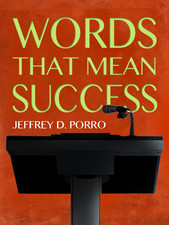
Book Spotlight: Words That Mean Success

The latest book in our spotlight is Words That Mean Success by veteran speechwriter Jeff Porro. Building on his extensive experience writing for Fortune 250 CEOs, government leaders, and the like, Porro packs a lot of wisdom into this short book.

Words That Mean Success underscores the importance of the spoken word in business and gives sage advice on how to improve public speaking and better engage audiences. And by gathering lessons from top CEO communicators like Warren Buffet and Steve Jobs, Porro shows the real-world benefits of being a great speaker. 

GG: What made you decide to write this book?
JP: I’d been thinking for a long time about updating and expanding some of my earlier writing on helping executives get the most out of the spoken word. But I have to admit that until recently, the thought of sitting down and doing a 200- or 300-page book was too daunting for me to even contemplate. Then I spoke with a friend who had just published a very successful business book, and he opened my eyes to an idea that now seems rather obvious: a lot of businesspeople are extremely busy and prefer books you can read in one sitting. I knew that was something I could write.

GG: Can you reveal a tip or two from the book?
JP: One is that the speechwriting process should start long before you put fingers on a keyboard. A good speechwriter begins by researching the venue, the audience, the speaker, and more. The other tip that may surprise people is that conflict is a good thing—at least in a speech. Lee Iacocca put it best when he wrote, “A good speech, like a good novel, is constructed around conflict.”

GG: How did you get started as a speechwriter?
JP: I became a freelance writer back in the 1990s, when the magazine where I was working let nearly the entire staff go at once. At first I did all kinds of writing and editing, then I narrowed my focus to what I call “promotional writing,” helping people and organizations get their messages out. I began to get bored with that, though, so I worked with an executive coach, Mitchell Groter, who helped me realize that speechwriting was really my strength.

GG: What attracts you to speechwriting? 
JP: I think it’s the fact that a great speech is an artful combination of a diverse set of elements. You have to capture the personality of the speaker, convey a specific messages, target a particular audience, and so on. Plus you can use humor, history, quotes, current events—it’s an exciting challenge to bring it all together and make it work.

GG: Do you have a favorite speech you’ve written?
JP: There is one in particular where all the elements came together exactly the way they should. It was the commencement speech Anne Goddard, the head of ChildFund International, gave at her alma mater, Assumption College, in 2009. She is a terrific woman with a great sense of humor, and she was very willing to share wonderful stories. I’m very proud of that speech, but Anne made my job pretty easy.

GG: If you had to sum up what you do in one word, á la Dan Pink, what would it be? 
JP: “Engage.” I help executives use speeches, talks, and presentation to engage their audiences.

Friday, June 1, 2012

Book Spotlight: The Insider's Guide to Book Publishing Success

We're very pleased to spotlight The Insider's Guide to Book Publishing, written by our friends at independent distributor Midpoint Trade Books: Eric Kampmann, Margot Atwell, and Sarah Lucie. Given the drastic shifts in the publishing industry in the past few years, this book could not be more timely. It is truer now than ever before that absolutely anyone can write and publish a book, yet the process remains daunting and opaque to most people outside the industry. This book will go a long way toward demystifying and illuminating the right steps to take on your publishing journey, helping prospective authors determine the best way to bring their books into the world. 


Gotham Ghostwriters spoke with Margot Atwell about the relevance of this book, the publishing industry today, and their new hybrid publishing division, Midpoint Plus.

Without revealing your secrets, can you give me a brief overview of what's covered in the book?
There are no secrets in the book, just straightforward information about publishing that we've learned from years (and, for Eric, decades) of experience in the publishing industry. It is divided into sections, each of which covers one aspect of publishing. "Publishing Overview" describes seven different publishing options for authors, from publishing with a major house to independent publishing with a distributor to an e-book-only launch. Other sections cover the manuscript, production, sales and distribution (two areas many authors know very little about), marketing and publicity, and finance. We also include case studies written by authors and industry professionals to show what a success story looks like from the inside, and how hard it is to make a book successful.

What do you think is the biggest challenge facing aspiring authors today?
Right now is a fantastic time to be an author, and options for publishing have proliferated to the point that whatever an author wants to do, he or she can do. There are so many different ways to publish a book, in e-book format or print. Tons of great writers who might have been overlooked by the major houses in the past can take their writing careers in their own hands and publish their own books, build their own markets, and see greater rewards than they would have under the traditional publishing model.

The greatest challenge facing authors is there is not enough information from reputable sources about how to make publishing decisions. Many authors decide to self-publish their books without knowing what it takes to do so, or what all the steps are. I see many authors looking to industry experts for help, and sometimes they find generous, knowledgeable people who can steer them in the right direction, while other times they find people who are much more interested in making money than in working with an author to find out what is right for his or her book. Authors can make unnecessary and costly investments in seminars that aren't helpful, cover designers who overcharge and under-deliver, or printing way too many copies of their book without any way to bring it to the market.

We wrote The Insider's Guide to Book Publishing Success to demystify the publishing process for people who have never seen it from the inside, and to arm them with the right questions to ask themselves and the people they might work with. We hope it will be a valuable tool for authors and new publishers.

Why was now the right time to bring this book out?
The industry is changing fast, and technology is allowing authors to publish their own books more easily and economically than ever before. At the same time, and probably because of that, self-publishing is losing the stigma it once had, and many more people are turning to self- and independent publishing. Even Book Expo America is acknowledging the massive rise in self-publishing with this weekend's UPublishU event at the Javits Center. We will be there giving away free copies of our book, so please stop by and say hi! We'll be at Booth #4345.

What makes your team uniquely qualified to write this book?
Eric has forty years of book sales and distribution experience. He has worked with independent book publishers since 1981, and has owned and run Midpoint, a distributor for over 250 independent publishers, since 1996. He has seen many major changes in the publishing industry and can put the current shifts in a broader context.

I am the Publisher of Beaufort Books, an independent publisher distributed by Midpoint Trade Books, so I have much more of an editorial and marketing background. This helps round out the book and give readers a wider view of publishing. We also called on other publishing professionals to provide information for key sections, such as special sales and social media.

Tell me more about Midpoint Plus.
We created Midpoint Plus to fill a need that we started to see more and more. Frequently, great authors who are becoming first-time publishers will approach Midpoint Trade Books looking for distribution. However, the learning curve for a first-time publisher is enormous, and most often, these authors' books would fail because they had overlooked one (or more) important piece of the publishing puzzle. Midpoint Plus is a publishing services company that can assist, guide, and mentor new publishers. We can help with just one part of the process—like finding and working with a cover designer to achieve a great professional-looking cover, or developing and implementing a marketing plan—or we can help with the entire process, from manuscript development to getting the books on bookstore shelves and beyond. Our books get national distribution into bookstores, wholesalers, online retailers, and appropriate specialty accounts through Midpoint Trade Books, and we have a very sales-oriented vision, which sets us apart from many other book doctors, book shepherds, and consultants, most of whom have an editorial background and might not be able to provide such holistic assistance or access to sales and distribution.


Margot Atwell is the Publisher of Beaufort Books, an independent book publisher based in New York City, and Director of Midpoint Plus, a publishing services company founded in 2011. Before joining Beaufort Books in 2006, she worked at the Irene Skolnick Literary Agency. When she is not working on books, she plays Gotham Girls Roller Derby under the publishing-appropriate moniker Em Dash.

Monday, December 12, 2011

Book Spotlight: 10 Steps to Writing a Vital Speech by Fletcher Dean

We're doing another new feature here on the BloGG: book spotlights! Our inaugural title is 10 Steps to Writing a Vital Speech by Fletcher Dean, one of the most seasoned and successful speechwriters in the world. This detailed, comprehensive, definitive guide was published by Vital Speeches of the Day, the most respected brand in the field. It's a fantastically thorough resource, and of course would make a terrific gift for any public speaker or communications pro on your holiday shopping list. 

Gotham Ghostwriters asked Fletcher Dean a few questions about his speechwriting life and his writing process. 
How did you get your start as a speechwriter?
It was entirely unplanned. I was an English major who turned to journalism to make a living, then I traded that for a better-paying job in corporate America doing mostly internal communications work. They thought I was a good writer and offered me a chance to do speechwriting, a position I hadn't even known existed in the company. Obviously, that was a career-changer for me, and I’ve never really looked back. I've been speechwriting for almost twenty years.

Do you have a favorite speech you've written? 
One of my favorites was written for Earnie Deavenport, the former CEO of Eastman Chemical Company and true Southern gentleman. He was scheduled to give a speech in New York almost exactly a year after 9/11, just blocks away from Ground Zero. For many attendees, this was their first time in New York since 9/11, so terrorism was front and center in their thoughts. We used that mind-set to our advantage, crafting a speech titled “Terrorism Is Not Our Greatest Threat.” It captured attention from the very beginning because it begged the question: if not terrorism, what is our greatest threat? This was a rare case where the first words I wrote of the speech were the title.

Putting the mechanics of the speech aside, what makes up your routine when you sit down to write? 
I divide my process into several steps. Sometimes they overlap, but I make sure to hit all of these at some point and in this order: 
  • Learn as much as possible about the audience and its concerns. 
  • Learn as much as possible about the topic. 
  • Discover the common problem or concern. 
  • Determine what we want the audience to do or believe about that problem.
Once I've accomplished all of that, I begin to craft some key messages and put that into a format that engages the audience. Then I write. Then I edit. And re-edit and re-edit and re-edit some more. I edit more than I write. Sometimes I think the job should be called “speech editor” instead of “speechwriter.”

Your book is very comprehensive, but can you suggest any other resources for speechwriters or aspiring speechwriters?
The Internet has not only revolutionized the way speechwriters do their jobs but also the way they interact with and learn from one another. There are several good blogs out there—from Jeff Porro, Nick Morgan, and Vital Speeches, just to name a few—that showcase real writers doing real work. There are many, many more, and the Internet is facilitating the development of a real community of speechwriters. That’s the easy way to learn about the profession. Then think seriously about some training. I started going to the Ragan Speechwriters Conference years ago and highly recommended it. (Full disclosure: I’m speaking there again in 2012.) There are also some good speechwriting coaches out there, like Joan Detz in Philadelphia and Wendy Cherwinski in Ottawa. Finally, though it may seem cliché, you learn by doing. There is no better way to learn to write than by sitting down and writing.