
Is Your E-Book a Fake? Knock-offs aren't just for fashion, and Amazon has become the Chinatown of e-book fakes. The online retailer's not just selling them—most of the offenders are products of Amazon's self-publishing imprint CreateSpace. If you're looking for Walter Issacson's bestselling bio of Steve jobs, make sure you don't get fooled by Steve Jobs by Issac Worthington. Beware of Fast and Slow Thinking by Karl Daniels, which strikes uncomfortably close to the real-deal Thinking Fast and Slow by Nobel laureate Daniel Kahneman. When searching for Girl with the Dragon Tattoo, one top result is I Am the Girl with the Dragon Tattoo. The solitary review for that book notes: "this is almost certainly copyright infringement. the author chose a
popular book title, added 'i am' to the beginning, and calls it
legitimate. of course, anyone who is looking for these things should
know better." Technically speaking, titles of books aren't copyrighted, but the legal line here is definitely blurry.
Stephen Covey's Legacy of Leadership Lit. Last week, author and father of the thought-leadership genre Stephen Covey passed away from injuries he suffered in a bike accident in April. Covey's seminal works—including 7 Habits of Highly Effective People, The 8th Habit: From Effectiveness to Greatness, and First Things First—have sold millions of copies and influenced
some of the biggest names in corporate America. It's arguable that 7 Habits was responsible for catapulting thought-leadership books from a niche market to a mainstream genre, as well as making a "book as badge" the new must-have for high-powered business gurus. So the next time you land
a high-paying job editing (or ghostwriting) a "big idea" piece for the latest whiz-kid CEO, thank Covey for paving the way.
Big Brother Is Reading You. Or, rather, he's reading your Kindle, according to the Wall Street Journal. E-books, which have officially outsold "analog" books this year, are the newest frontier of consumer data mining. Until now, publishers have been mostly in the dark about what happens after a book leaves the store, but no longer. Whether you download a book but don't read it, start a book and don't finish it, or tear through an entire series in a matter of days, that information is now available to those who most want to know. Some publishers are excited about the opportunity to hone their offerings according to market forces, like finding the perfect length for an e-book or coming up with a formula for ideal content, but others fear that a data-driven marketplace will have a homogenizing effect, not to mention potential privacy pitfalls. What do you think? Can boiling the book business down to an algorithm be good for the marketplace and the marketplace of ideas? Or does having the publishing industry reading over your shoulder give you a case of the digital willies?
Scalia Rules on Crimes Against Grammar. What do liberal lawyer Bryan Garner and conservative SCOTUS Justice Antonin Scalia have in common? According to this New Yorker piece, they're both SNOOTS set on righting the wrongs legal writing exacts on the English language. The two men, who bonded during a lunch meeting at which Scalia gushed over David Foster Wallace's essay "Tense Present," have collaborated on two books about the role of grammar and persuasion in legal writing. Although they disagree about politics—and the acceptability of contractions (which, according to Scalia, are “intellectually abominable, but commercially reasonable”)—they were able to withstand an exacting collaboration that produced 216 drafts before finalizing their second book, Reading Law: The Interpretation of Legal Texts. While their partnership has begun to shine a light on the issue, Garner is well aware that it'll be an uphill battle to raise the, er, bar when it comes to legal writing. “Word for word," he said, "lawyers are the most highly paid
professional writers in the world. But the literary tradition in the
profession is probably the worst."
Showing posts with label wall street journal. Show all posts
Showing posts with label wall street journal. Show all posts
Thursday, July 19, 2012

Thursday, December 22, 2011
Guest Post: The Literary Ghosts of New York City by David Alm
Today we have another guest post about the Gotham Ghostwriters holiday gathering, this one by David Alm, writer, ghostwriter, reporter, editor, and professor of media studies and cultural criticism at Hunter and NYU, respectively. This article was originally published on Contrary Magazine, where David is one of the primary writers.
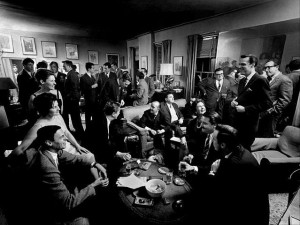 |
| A gathering at George Plimpton's apartment in 1963. We might not be famous like they were, but at least we're here |
I had no idea what to expect. A holiday party for
ghostwriters sounds like scene in a Woody Allen movie from the late 80s. A
bunch of disgruntled, hyper-cerebral guys in well-worn corduroy jackets sipping
G&Ts and swapping stories about dropping acid with Cary Grant or Henry
Kissinger’s bathroom habits. So as I made my way to the Gotham Ghostwriters
holiday party last night, I braced myself for the unexpected.
I also wondered what kind of literary life might still exist
in the shadows of New York City, which has rapidly become so transformed by
high finance that it bears almost no resemblance to the grimy artistic mecca
that provided the foundation for Woody Allen’s fictions. Had the shabby-chic
literati of yesteryear been expelled from Manhattan along with the independent
bookstores and cafés?
From what I saw last night, no. They’re still here, still
writing, still swapping stories, and still wearing corduroy jackets. (At least
some of them are.) There are women, too, of course, and they don’t all look
like Susan Sontag—that is, severe, intense, poised to challenge your every
word.
And they’re still lively, cerebral, and full of
self-deprecating wit. I spoke with a man who’s ghosted 43 titles, including a
memoir about the Rwandan genocide, and who began his literary career as a
songwriter. I spoke with another who’d spent years reporting for American
newspapers in Cambodia and Thailand. I spoke with a young guy from London who
used to write about foreign policy for the Wall Street Journal. Everyone, in
his or her own way, was fascinating.
Ghostwriting is solitary, often thankless work. You can toil
away for months to capture a client’s “voice.” In the end, you might get a
decent paycheck, but more likely you’ll make a piddling sum compared to what
your client earns for your efforts. And rarely do you ever meet other “ghosts.”
I have ghostwritten only two books, for the same client, and in the 10 years
since I wrote the first one I have never met another ghostwriter. You put a few
dozen of us in a room together, and it’s instant community.
Indeed, last night felt like a reunion, though everyone
there was a stranger.
So, as yet another corner coffee shop is replaced with a
Starbucks, another East Village walk-up is gut-renovated and parceled out in
$2-million pieces, and another glass-and-steel monstrosity rises along the West
Side Highway, it’s nice to know that people are still gathering in little bars
to talk about writing. Even if no one will ever know our names.
Friday, December 9, 2011
Around the Word
Self-pub superlatives: Highlighting the recent trend of self-published authors striking it big, the Wall Street Journal ran a story on best-selling author Darcie Chan today. Like other self-pub standouts, Chan had a great novel but no publisher. She turned to e-books to find and outlet for her work and has sold 400,000 copies, putting her on par with other successes like Amanda Hocking and John Locke.
A showroom of one's own: We wrote earlier this week about a recent poll finding that 24 percent of online book buyers purchase a book after seeing it in a brick-and-mortar store first, a practice referred to as "showrooming." In Time magazine this week, Emma Straub, a bookseller at Brooklyn's BookCourt, gives her two cents about this alarming trend. Though Amazon offers access to books for many people who aren't lucky enough to have a local bookstore, Straub takes issue with people who use BookCourt as a showroom. "We’re talking about the people who do live close enough to independent bookstores to stroll their aisles," Straub writes. "Because this story is about those people selling the bookstores out for a better deal." What do you think? Are showroomers soulless or just savvy shoppers?
Vital visibility: Online writers often struggle with a difficult challenge: how do you make your writing audible over the noise of the rest of the Internet? Author and content marketing expert Rebecca Lieb gave an illuminating interview to GalleyCat with tips on how to make your work stand out. For example, she says that writers have a leg up, given that search engines traffic in the written word. What tips do you have for writing attention-grabbing content?
Greatest gobbledygook: The Plain English Campaign is on a mission to end pretentious jargon and confusing public communication in the UK. This year, the organization has awarded the UK's Meteorological Office their Golden Bull "booby prize" for the worst offense in public discourse: The Met Office began predicting "probabilities of precipitation" instead of the chance of rain last November. The Plain English Campaign describes their motivations to the BBC: "Even though most people agree that plain English is plain common sense, our government needs to make it a legal duty that public communications are crystal-clear." Do you agree?
A showroom of one's own: We wrote earlier this week about a recent poll finding that 24 percent of online book buyers purchase a book after seeing it in a brick-and-mortar store first, a practice referred to as "showrooming." In Time magazine this week, Emma Straub, a bookseller at Brooklyn's BookCourt, gives her two cents about this alarming trend. Though Amazon offers access to books for many people who aren't lucky enough to have a local bookstore, Straub takes issue with people who use BookCourt as a showroom. "We’re talking about the people who do live close enough to independent bookstores to stroll their aisles," Straub writes. "Because this story is about those people selling the bookstores out for a better deal." What do you think? Are showroomers soulless or just savvy shoppers?
Vital visibility: Online writers often struggle with a difficult challenge: how do you make your writing audible over the noise of the rest of the Internet? Author and content marketing expert Rebecca Lieb gave an illuminating interview to GalleyCat with tips on how to make your work stand out. For example, she says that writers have a leg up, given that search engines traffic in the written word. What tips do you have for writing attention-grabbing content?
Greatest gobbledygook: The Plain English Campaign is on a mission to end pretentious jargon and confusing public communication in the UK. This year, the organization has awarded the UK's Meteorological Office their Golden Bull "booby prize" for the worst offense in public discourse: The Met Office began predicting "probabilities of precipitation" instead of the chance of rain last November. The Plain English Campaign describes their motivations to the BBC: "Even though most people agree that plain English is plain common sense, our government needs to make it a legal duty that public communications are crystal-clear." Do you agree?
Wednesday, November 30, 2011
Around the Word
Self-pub skeptic: While there is a lot of enthusiasm for self-publishing as a "bright spot" in our changing media industry, not everyone is so convinced of its merits. Novelist and writer for The Millions Edan Lupecki gave her "Reasons Not to Self-Publish in 2011–2012: A List," highlighting several problems with self-pub enthusiasm, such as overlooking small presses, finding an audience, and signing yourself over to the all-mighty Amazon. Does Lupecki have a point? Or is she just a luddite?
Non-required readings: Author readings used to be the bread and butter of a book tour, but with shortening attentions spans and higher expectations for author engagement, many audiences aren't happy to sit through several chapters read aloud. The Wall Street Journal takes a look at the changing nature of the book tour, which now often includes extras like a lecture, presentation, interview, or panel discussion. Is this change for the best, or do you miss the old-fashioned readings?
WordPress to printing press: Social media guru Chris Brogan turned his attention to digital publishing this week, highlighting a new company called PressBooks. PressBooks lets authors create books using WordPress and format them for print, e-books, and tablets. Check out an interview on his site with the founder of PressBooks where they discuss the publishing e-volution.
Collapse of the E-uro? The European debt crisis and fragility of the Euro have been grabbing headlines for weeks, but Publishing Perspectives has taken a narrower view of Europe's economic woes: Would a collapse of the Euro slow European e-book adoption? The Euro is attractive for e-book distributors because it facilitates easier transactions and eliminates foreign exchange fees. Do you think the end of the Euro would also end the e-book?
Non-required readings: Author readings used to be the bread and butter of a book tour, but with shortening attentions spans and higher expectations for author engagement, many audiences aren't happy to sit through several chapters read aloud. The Wall Street Journal takes a look at the changing nature of the book tour, which now often includes extras like a lecture, presentation, interview, or panel discussion. Is this change for the best, or do you miss the old-fashioned readings?
WordPress to printing press: Social media guru Chris Brogan turned his attention to digital publishing this week, highlighting a new company called PressBooks. PressBooks lets authors create books using WordPress and format them for print, e-books, and tablets. Check out an interview on his site with the founder of PressBooks where they discuss the publishing e-volution.
Collapse of the E-uro? The European debt crisis and fragility of the Euro have been grabbing headlines for weeks, but Publishing Perspectives has taken a narrower view of Europe's economic woes: Would a collapse of the Euro slow European e-book adoption? The Euro is attractive for e-book distributors because it facilitates easier transactions and eliminates foreign exchange fees. Do you think the end of the Euro would also end the e-book?
Subscribe to:
Posts (Atom)
© 2008 Gotham Ghostwriters, All rights reserved.

 Posts
Posts


