Friday, March 8, 2013

Why a CEO Should Never Deliver a TED-Style Talk

By David Murray 

CEOs don’t want to look too polished, because they think they’ll be branded as shallow.

A speechwriter friend of mine at a Fortune 100 company complained that CEOs all recognize that the TED Talk is The Way to Communicate. But then they refuse to do TED-style delivery. He recognized that part of the reason is because TED Talks take a ton of time and energy to prepare for.

“Practice when you feel like it,” advises recent TED Talker Nilofer Merchant.

And, even when you don’t feel like it. At least two weeks out from a big talk, start to deliver the talk with notes and ultimately without them. Memorize where possible. I say it to myself 15 minutes every day. And once right before bed. Then I get a full night of restful sleep so that some part of my brain commits it to memory. At one week out, I’ve moved to keywords on Post-it notes. By five days out, I am no longer looking at any notes. I usually wake up the full week before a talk with it playing in my mind. You want it in there, even though it won’t actually be the talk that’ll come out that day. There is the talk you plan on giving and the talk that you give. If you are great at performance and memorization, it’s quite possible for those to be one and the same. But the more important thing to happen is for you to know what you came to say and know it well.

Now, what CEO is going to sweat a speech like that?

But a more fundamental problem is: What CEO wants to be thought of—by investors, employees and maybe most importantly, by CEO peers—as someone so focused on public performance? And thus not focused on analysis, deal-making and decision-making that we expect CEOs to be thoroughly absorbed in at all times?

And that self-conscious CEO has a point. Aside from Steve Jobs, whose performances we saw as the spearhead of the company’s new product sales, wouldn’t you harbor some suspicion about the vanity and greater ambition of a CEO who delivered a perfect TED Talk?

Not that there isn’t a mile of middle ground between TED perfection and the typical CEO speech. And not that TED Talks don’t model many of the tools—economy, focus, storytelling, personalization—that we urge our clients to use. But if TED is actually not the ideal in executive communication, then let’s not punish ourselves and our clients by pretending it is.

David Murray, who has covered speechwriting and executive communication for nearly two decades, is editor of Vital Speeches of the Day. This post originally appeared on the VSOTD blog.

Wednesday, March 6, 2013

Around the Word: Book Discovery

Book Discovery. How do readers decide what book to read next? This process, known as "book discovery," is the latest buzz phrase in the online book marketing world. Every day there seems to be a new article or blog post debating the merits of various websites hoping to woo visitors with their book recommendations or browsing tools. This trend is growing so quickly that Publishing Perspectives is already asking if the book discoverability bubble is ready to pop. Trying to make sense of it all? A recent article on Forbes clearly lays out the online book market, customer habits, and book discovery options.

Decisions, Decisions. With so many websites trying to find the sweet spot of book discovery, there are lots of options to explore. Most people are familiar with Amazon's recommendations. But if you're looking for a more tailored experience, many book discovery websites are trying to more carefully cater to customer preferences. Bookish, launched earlier this year, is "an exercise in big data" as CEO Ardy Khazaei explains. The site will use everything from genres and authors to editorial themes and reviews to make its recommendations. Then there's Goodreads, probably the most well known and established book discovery tool, which crowdsources peer recommendations and reviews to make its selections.  Looking for something a little more exclusive? Riffle is a new invite-only book discovery site that's been compared to Pinterest. It's powered through a Facebook app that allows users to share books with friends, create lists, and see industry experts' curated pages. Still hungry for more book discovery options? Check out The Nudge List, Amazon's Shelfari, or Rabble, a Rotten Tomatoes–like website with expert reviews that is set to launch in April.

Word of Mouth. Even with all these options, the real-world experience of getting book recommendations from friends still reigns supreme. A recent Goodreads survey found that "trusted friend" remains the top reason respondents decided to read a book, followed by "everyone talking about it" and "book club." Another study, conducted by Codex Group, underscores just how far online book discovery has to go: only 7 percent of frequent online book buyers said they actually "discovered" the last book they purchased on the internet. Why can't book discovery websites seem to break through? The New Republic's Hillary Kelly has a thoughtful take: "Data has no imagination. When it comes to book recommendations, attempts to sort or streamline or mathematize them necessarily dehumanizes the process. The very nature of the endeavor, much like digesting Ulysses, requires an infinitely more complex machine: the human brain."

Tuesday, February 26, 2013

Gotham Is Hiring

Our firm is starting a search this week to fill a new position with our Bookwriters Group -- Director of Business Development.

This job is ideally suited for a literary agent or publicist who knows the publishing industry well, has experience pitching and closing clients, and is eager for a new challenge with high-reward potential.

Below is a full job description outlining the responsibilities and qualifications. You can also view the job listing online here.

Anyone interested in applying should send a cover letter and resume to:
dan@dangerstein.com.


Director of Business Development
Bookwriters Group

SUMMARY: Gotham Ghostwriters, New York’s only full-service writing firm, is seeking an entrepreneurial publishing professional with strong industry relationships to lead and scale up our growing bookwriting practice. This is a rare chance to capitalize on a sure thing -- or as close to it as you’ll get in today’s unsettled publishing world. Our Bookwriters Group is playing in a booming market with no real competition and, best of all, an unbeatable asset: the peerless network of more than 200 accomplished ghostwriters and editors we have built since launching the division two years ago. The reputation we have developed for delivering reliably high-quality service to the diverse universe of authors we work with -– from top CEOs and tech experts to the next generation of thought leaders looking to make a name for themselves -- doesn’t hurt either. All we need now is to find a dynamic, well-connected salesperson and manager who can help us expand that brand, cultivate new sources of business, and take full advantage of our unique capacity to custom-match editorial talent with authorial need. This position is ideally suited for a literary agent or publicist who is already versed in the art of smart content and eager for a new challenge with high-reward potential.

RESPONSIBILITIES: The director of business development (DBD) will work closely with the firm’s president and director of operations to: raise awareness of our Bookwriters Group in general and deepen our connections within the publishing industry in particular, identify and close new business opportunities, and manage relations with clients the DBD brings into the firm.

More specifically, the DBD will be responsible for:
  • Formulating and executing long-term business development and marketing strategies
  • Meeting with literary agents and publicists, editors at major houses, and other publishing and communications professionals who could be potential sources of business
  • Representing the firm at major industry conferences
  • Organizing events to increase brand recognition
  • Negotiating terms and drafting contracts for clients they bring in
  • Serving as the first point of contact for clients under contract
  • Overseeing the assignment of writers to their projects

QUALIFICATIONS: This position requires substantial knowledge of the publishing industry and the craft and business of writing; strong people, pitching, and relationship-building skills; and a mix of initiative, creativity, and business savvy.

In addition, the ideal candidate will have:
  • A minimum of 3-5 years experience working in a business development capacity at a literary agency, PR firm, or major publishing house
  • A wide network of connections throughout the publishing industry
  • Excellent writing ability
  • Enthusiasm for working in a start-up environment

COMPENSATION: Comparable to a literary agency -- modest base salary plus commissions on all new business the DBD is directly responsible for bringing into the firm. Health insurance provided.

APPLICATIONS: If you are interested in being considered for this position, please send a cover letter and resume to: dan@gothamghostwriters.com.

Friday, February 22, 2013

Around the Word: (Belated) Valentine's Edition

Bringin’ Grammar Back. It’s time for the revenge of the grammar nerds! Proofreading company Kibin did a survey of 1,700 online daters and their feelings about grammar, and the answers might surprise you. Not only did 43 percent of respondents say that poor grammar is a “major turn-off,” but 35 percent said they find good grammar sexy. That’s a win for grammar lovers everywhere! And it’s not just Kibin. Match.com’s survey of 5,000 online singles found that when sizing up a potential date, both men and women ranked grammar as very important—right after teeth. So if “C U L8ter” is like nails on a chalkboard for you, take comfort in knowing that you’re not alone. Next up? "Grammar Is Sexy" t-shirts for all!

Ghostwriting Cupids. In honor of everyone’s favorite holiday for love, let's take a look at the softer side of ghostwriting. Dating consultants are getting into the e-dating business to help singles with everything from editing and writing their profiles to crafting the perfect flirtatious email. So far only 14 percent of online daters have someone proofread their profiles, but the “Cyrano for hire” business is taking off. Want to see a ghostwriting cupid at work? New York Magazine gave an inside look at one consultant’s handiwork. And perhaps as word spreads that grammar is sexy, more singles will seek out dating ghostwriters to avoid becoming Dating Profile Disasters fodder.

Dating by the Book. Most people know of the eHarmonys and Match.coms of the online dating world, but for those with a much more specific checklist for prospective partners, there's a vast subset of niche dating sites. For political junkies who don’t want to date across the aisle, there's love along party lines on redstatedate.com and bluestatedate.com. If computer choice is a deal-breaker, Cupidtino caters to those who only want to date Mac owners. So naturally book lovers have their own niche dating site: Alikewise. Started in 2008, the site matches users based on their taste in books, using an algorithm similar to Amazon’s. Interested in joining? Flavorwire has 25 Pickup Lines to Use on Alikewise to get you started.

Friday, February 15, 2013

Writer Poll: Would You "Out" a Troublesome Client?

In a recent issue of Vanity Fair, Rich Cohen wrote a revealing article on his experience as a ghostwriter for late businessman and philanthropist Teddy Forstmann. The piece straddles the line between profile and exposé as Cohen shines a light on intimate details of the time he spent working with Forstmann on his memoir.

It’s an intriguing piece that raises the issue of what, if anything, a ghostwriter should reveal about his clients after they’ve finished working together. We reached out to our network of ghosts to find out whether they would ever “out” a high-profile client as troublesome or difficult to work with. Although many could empathize with Cohen’s struggle, most said they would never divulge private details about their clients’ lives.

For one GG writer, the Vanity Fair piece hit particularly close to home: Karl Weber worked for Forstmann some time before Cohen took on the task, and he had an equally difficult experience working with the businessman: “Yes, I was one of Rich's several predecessors who, like Rich, found it impossible to fulfill the task to Ted's satisfaction. Rich's article gave me the satisfaction of saying, ‘Well, at least now I know it wasn't just me!’”

Speechwriter Ian Griffin has also grappled with difficult clients but said he would never expose one: “
I'd never ‘out’ a problem client, even a deceased one, whose money I'd taken (not to mention whose hospitality I'd enjoyed at fine dining establishments and on private jet trips around the world). I make my living as a speechwriter, not a ghostwriter, but both professions require absolute discretion. Many high-profile people are ‘difficult,’ but if we take the assignment we should keep those difficulties to ourselves.” Editor Margot Atwell agreed: “I definitely would not. In this business we're trading on our reputations, and discretion and professionalism are important. If I were a client looking for a ghostwriter and an article like that popped up under a prospect's name, I would have a difficult time trusting that person.”

Other writers agreed that Cohen’s decision to write the piece was unprofessional. Meakin Armstrong said, “I don’t think someone else's lack of professionalism means you can be unprofessional, too.” Tim Vandehey concurred: “Pro ghosts should keep their client troubles confidential. You never know who might out you.”

Jack Rochester noted that Cohen’s lack of ghostwriting experience is evident in this piece: Cohen admits this is his first fling with ghostwriting, and it shows. I don't see any attempts to reach conciliation or consensus with his author-client, only a brooding, unvoiced resentment. In my opinion, Cohen displays a lack of respect for his author-client, and for the ghostwriting process as well.”

For Joseph Dobrian, it came down to the issue of money. “I would only ‘out’ a client who welshed on the payment. Then I'd warn everybody I could that this person is a liar, a cheat, and a thief.”

Many of our writers didn’t see the issue as quite so black and white. Lauren Paul said, “Absent a contract barring disclosure of the identity or personal information related to the client, it is legally acceptable to write that sort of piece. Cohen very much dimmed his ghostwriting prospects by doing so, but since he never wanted to be a ghost in the first place, that's probably fine with him.”

Howard Rothman took a similar stance: “I think it's okay in this case because (a) both the client and the project are dead, and (b) Cohen says he didn't violate anything in his NDA. I think it's also good that Cohen doesn't make his living as a ghostwriter, because it's not likely that anyone aware of this article will ever hire him in the future.”

Steve George sympathized with Cohen’s struggles, but said that it's the sort of thing that sometimes comes with the territory. “My only negative reaction to the article came at the very end, when Mr. Cohen feels sorry for himself, writing, ‘I am nobody. I'm the ghost.’ I, too, have felt invisible around people attending to a high-profile client, and that can be a bummer, but I also recognize that I am very important to the high-profile client. And he's the one that matters.”

It seems like all of our writers agree: “outing” a client, whether ethical or not, is simply bad for business. “For those who make their living as ghostwriters, it would be unwise to be seen as a ‘kiss and tell’ ghost,” said Laurel Marshfield.

Friday, January 18, 2013

Guest Post: What Leaders Need: A Confident Confidant

By Ian Griffin
This piece originally ran on Ian's blog, then on Vital Speeches of the Day

Seven years ago this month, I started the Professionally Speaking blog. Now I’ve reached the milestone of 700 blog postings. This seems like a suitable moment to reflect on some of the key lessons I’ve learned from my experience in providing executive communications support to my clients in Silicon Valley and around the world. You know you’ve hired a world-class speechwriter and communications consultant when they embrace these seven qualities.

1: CEOs need a confident confidant
Sitting in meetings at major Silicon Valley companies such as Sun Microsystems, Hewlett-Packard and Cisco, I’m often the only person in the room without a few thousand people reporting to them or a multi-billion-dollar target to meet. This can be an incredibly useful role that a CEO will come to value. As the speechwriter, I’m the one person in the room the CEO can turn to without an agenda of my own to advance. A CEO once told me, “Ian, it’s lonely at the top. I’ve seen every scam that managers can pull to cover their rear ends. I need someone like you who can tell it like it is.”
Key Lesson: Speechwriters with the confidence to speak up become the confidant and trusted adviser of a senior executive.

2: Be an impartial observer
I was brought in to edit an annual report for a European client with four separate divisions. My role was to resolve the different viewpoints of each group. The VP of Communications needed an outside consultant with the independence required to be able to write a cohesive document. Executive communications professionals are in a unique position to be an impartial observer in large organizations with multiple departments and competing interests.
Key Lesson: Take the initiative and tell the truth, no matter what certain executives want to hear. But don’t take sides within a company. We need to keep lines of communication open to all parties.

3: Take complexity out
Companies are filled with subject matter experts (SMEs) in engineering, finance, marketing, and sales. A speechwriter is a jack-of-all-trades, master of none. That’s our hidden value to a company. It’s my job to know a little bit about everything the company does, and then to know who to ask for answers when I need details. But lack of detail is rarely an issue. Time and again, I’ve asked SMEs for the background needed for 5-10 minutes of a speech only to be given enough data for a two-day seminar. My job is to absorb enormous volumes of data and take the complexity out; to find a way to communicate the message without putting the audience to sleep.
Key Lesson: Learn to simplify. Only include what is necessary to convey what is essential. As Einstein said, “Everything should be made as simple as possible, but not simpler.”

4: Tell compelling stories
As has been noted by others, people may not remember what you did or said but they will always remember how you made them feel. Audiences forget facts but they remember stories. Once you get past the jargon, the corporate world is an endless source of fascinating stories. I’ve found the best source of great stories for speeches come from informal chats when you are sitting down over coffee or, as I did one memorable afternoon, sharing a beer and pizza with the CEO in Boston’s North End. We talked about our time there as students. He shared a story about the lessons he’d learned outside the Harvard classroom that I used in a future speech.
Key Lesson: Always listen for stories executives tell about their childhood, family life, hobbies, early career and more. Dig for specifics. As speech coach Patricia Fripp says: “Specificity builds credibility.”

5: Embrace multimedia
The one-hour keynote is an endangered species. Conference organizers know audiences have short attention spans. Given travel budget restrictions, many organizations are turning to virtual meetings. Executives now need to feel comfortable on camera as well as on the podium. My three years as a communications consultant at Cisco introduced me to the exciting possibilities of TelePresence meetings. I also enjoyed access to fully-equipped TV studios to produce All Hands meetings. But it was just as exciting working with the limitations of a simple Flip camera, capturing video which I edited with Windows Movie Maker. These days it’s not just enough to write clever speeches, you need to keep current with the latest in multimedia technology.
Key Lesson: Digital media expands the boundaries of executive communications. Suggest it as an alternative to travel; use it to time-shift; create content that includes outdoor shots, audience testimonials and impromptu out-takes; record staff interviews; livestream events; experiment with transmedia storytelling.

6: Open up the backchannel
The audience is no longer silent. They might look like they are sitting quietly, but a raging debate on what Cliff Atkinson called The Backchannel can occur within and beyond the confines of the presentation venue. I’m amazed at the resistance some speakers have to this. My experience curating Twitter hashtags for specific events shows that there’s a rapidly emerging opportunity to magnify the impact of a speech and increase the reach beyond the walls of the auditorium.
Key Lesson: Learn about and embrace the backchannel. Make sure your executive has a Twitter account and use it for shameless self-promotion and to stimulate a lively debate before, during and after each presentation they make.

7: Learn to ask the right questions
As a communications professional, it’s not your role to out-gun the SMEs, VPs and assorted executives in the C-Suite when it comes to content. Our role is to ask what headline the CEO wants the speech to generate. To find out the audience’s hot buttons. To uncover the unique point of view the speaker brings to the issue. If there’s one lesson I’ve taken away from the work I’ve done for clients, it’s to always be ready to ask “Why is that?” when they suggest a point they want to make in a speech. Then, when they give an answer, having the courage to ask the same question again. It’s often only after they answer for the third time that the core of the speech is revealed.
Key Lesson: Don’t hurry to get to a final draft. Be professional and respect deadlines, but keep asking questions until you reach an answer that will make the audience sit up and take notice.
What executive communications lessons have you learned?

Ian Griffin is a veteran speechwriter and blogger at Professionally Speaking who helps high-level executives craft their communications. He previously worked in the corporate communications departments at Cisco, Hewlett-Packard, and Sun Microsystems and has over twenty years of speechwriting experience.

Thursday, January 3, 2013

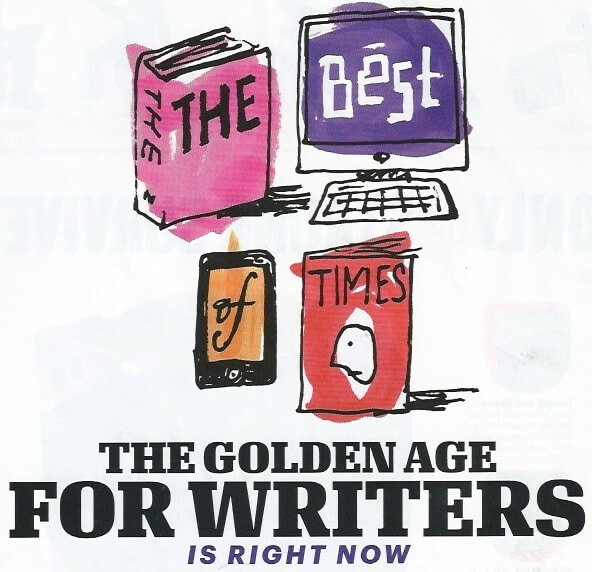
Writer Poll: Are We in a Golden Age of Writing?

Esquire recently published a piece called "The Golden Age for Writers," which argues that writers have no idea how lucky they are to live in these times of plenty for all things surrounding the written word.

Evidence cited for this claim includes new blockbusters coming out this year by powerhouse writers like Salman Rushdie and Zadie Smith, the fact that J.K. Rowling is a billionaire, and the way Fifty Shades of Grey has swept the world. In addition, publisher revenues are up, and there is more excellent long-form writing available to more people than ever before. The crux of the piece: "Literary circles have been so full of pity for so long that they can't accept the optimistic truth: We're living in a golden age for writers and writing."

Did Esquire miss something major in their relentlessly rosy assessment? Or is it time for everyone to stop howling about the death of the written word? We decided to go straight to the source and ask our vast network of hard-working writers to weigh in.

The positive
I totally agree. The article didn’t even touch on our ability to put out our own ebooks at will and sell them on Amazon, one of the largest search engines online. Writers now are truly blessed!
Carol Tice

Yes, everything is going digital but websites can't function without words. I'm constantly approached by businesses looking for words for their social media, blogs, or websites. Marketing copywriting and social media writing can earn you a steady income while you focus on passion projects on the side. There are many writers (like Diablo Cody, Amanda Hocking, and Kelly Oxford) who found success through social media and self-publishing. There are few barriers holding us back. We can market and publish ourselves, which brings an insane amount of opportunity for writers.
Aubre Andrus

I think we are at the beginnings of a golden age for writers due to the proliferation of paths by which writers can get their work in front of readers: print on demand, partner publishing with companies like Greenleaf Book Group, funding via sources like Kickstarter and PubSlush, direct-to-ebook publishing via the Kindle store or through companies like BookBaby, and so on. For ghosts, more paths to publishing means more people writing books and more quality work for us. Sure, doing all your own marketing is a lot of work, but since when was being a successful writer not a lot of work? I think this is a great time to be a writer, so long as you're entrepreneurial.
—Tim Vandehey

We are witnessing a resurgence for authors as we have grappled with and figured out ways to take advantage of new technologies and the Internet. As a ghostwriter, my business is certainly increasing. Yes, I too suffered through the doldrums of believing our industry and our very lives were heading over our own fiscal cliff. But all the way back in 1995, my MFA writing professor announced that we students were getting into the writing business just as it was dying. Perhaps people perpetually make these claims to discourage others, to thin out the herd.  
Alex Dahlberg  

Certainly the availability of written works in electronic form and new advances in self-publishing are both good for writers. But the Internet and social media have enticed regular people (not professional writers) to do much more writing than ever before. Vast numbers of people are writing more than ever, because they have the motivation that every English comp instructor has struggled for so many years to provide: to write about something you know and care about and have some aim or purpose with regard to the reader. The world is now one big writing workshop! 
Alan Perlman, PhD


The dubious
Content is still king, but all of us who deal in content—one way or the other, in any venue—are trying to figure out the new rules of the game. And we have to start from the position that even if we do figure out the rules today, they will be very different in a year’s time. So yes, there are more outlets, but we face a lot more complications and the road map isn’t clear.
Al Emid

I agree with the premise on one side: There are now, thanks to the Web, an infinite number of outlets for anybody who wants to express an idea or tell a story. On the other side, while I see that for authors who hit it out of the park, there is more visibility to be had, a larger audience of readers, and more money to be made than ever, the question is, is this not a zero-sum game? I think the long-term answer is going to be that writers will become entrepreneurial and learn to use the Web and other tech to promote and distribute their own work. But in the interim, as with every other media business, writers will face more suffering before it gets better.
Robert Chandler

I do not "howl self-pityingly" about "the death of the written word"; I've put two daughters through college as a freelance writer. However, the Esquire view is just nutty. Writers today are expected to produce work for close to nothing! But the good news is that, because of the enormous demand for content to fill digital media, it is much easier today to get some stories published and have a bunch of published clips to show.
—Steven Flax

Yes, developments in technology, blogging, and social networking have made it simple for anyone who shares a thought or a comment to become a "writer." Does that make it a golden age for writing, though? This is doubtless a time of great quantity, but what about quality? I believe we should aspire to a golden age of literacy, which would benefit writers, publishers, and readers alike.
—Katie Light


The negative
If the Fifty Shades books are responsible for the rising numbers, discount those numbers. Those books are dreck. And in any case, sales are one thing, but income for writers from those sales is another. To the extent that the numbers reflect Amazon's long tail, they don't help writers much. Mid-list advances and income are incontrovertibly down (although the long-tailers and mid-listers never made enough anyway). For readers, though, it's tough to complain.
—Mike Bryan

Except for the fact that writers are making far less than Esquire paid in the 1960s and '70s, this truly is a “golden age”—for publishers.
David Kline

All that the Esquire piece seems to argue is that life's not so bad if you're Jonathan Franzen. If the author of the article had talked to more mid-listers or hopeful talents who can't get their first fiction placed among the Big Five, he might have reached a different conclusion.
—Mike Gural-Miaello

Sure! Golden age! Unless you're interested in pesky things like, oh, getting paid. And I would point to Esquire's own website, where they pay a WalMart-like $150 for a 1,000-word piece. Where do I apply for food stamps again?
—Allen St. John


What do you think of our writers' conclusions? Tell us in the comments. And by all means, keep writing!