Thursday, December 22, 2011

Guest Post: The Literary Ghosts of New York City by David Alm


Today we have another guest post about the Gotham Ghostwriters holiday gathering, this one by David Alm, writer, ghostwriter, reporter, editor, and professor of media studies and cultural criticism at Hunter and NYU, respectively. This article was originally published on Contrary Magazine, where David is one of the primary writers. 
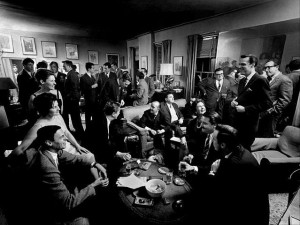
A gathering at George Plimpton's apartment in 1963.
We might not be famous like they were, but at least we're here
I had no idea what to expect. A holiday party for ghostwriters sounds like scene in a Woody Allen movie from the late 80s. A bunch of disgruntled, hyper-cerebral guys in well-worn corduroy jackets sipping G&Ts and swapping stories about dropping acid with Cary Grant or Henry Kissinger’s bathroom habits. So as I made my way to the Gotham Ghostwriters holiday party last night, I braced myself for the unexpected.

I also wondered what kind of literary life might still exist in the shadows of New York City, which has rapidly become so transformed by high finance that it bears almost no resemblance to the grimy artistic mecca that provided the foundation for Woody Allen’s fictions. Had the shabby-chic literati of yesteryear been expelled from Manhattan along with the independent bookstores and cafés?

From what I saw last night, no. They’re still here, still writing, still swapping stories, and still wearing corduroy jackets. (At least some of them are.) There are women, too, of course, and they don’t all look like Susan Sontag—that is, severe, intense, poised to challenge your every word.

And they’re still lively, cerebral, and full of self-deprecating wit. I spoke with a man who’s ghosted 43 titles, including a memoir about the Rwandan genocide, and who began his literary career as a songwriter. I spoke with another who’d spent years reporting for American newspapers in Cambodia and Thailand. I spoke with a young guy from London who used to write about foreign policy for the Wall Street Journal. Everyone, in his or her own way, was fascinating.

Ghostwriting is solitary, often thankless work. You can toil away for months to capture a client’s “voice.” In the end, you might get a decent paycheck, but more likely you’ll make a piddling sum compared to what your client earns for your efforts. And rarely do you ever meet other “ghosts.” I have ghostwritten only two books, for the same client, and in the 10 years since I wrote the first one I have never met another ghostwriter. You put a few dozen of us in a room together, and it’s instant community.

Indeed, last night felt like a reunion, though everyone there was a stranger.

So, as yet another corner coffee shop is replaced with a Starbucks, another East Village walk-up is gut-renovated and parceled out in $2-million pieces, and another glass-and-steel monstrosity rises along the West Side Highway, it’s nice to know that people are still gathering in little bars to talk about writing. Even if no one will ever know our names.

Wednesday, December 21, 2011

Around the Word

A Writer's Life. Over on Thought Catalogue, video-game journalist Leigh Alexander has a comprehensively sardonic explication of the joys and horrors of being a freelance writer. Covering things like how much to drink, how long to wear that pair of sweatpants before shudderingly tossing them in the hamper, and which things conspire against you to make you miss yet another deadline (hint: Facebook), "How to Be a Freelance Writer" lays out all the aspects of the writing life that most of us don't really want to admit to.

iNovel? According to MediaBistro (who heard it from Good E-Reader), next month Apple is probably going to unveil new self-publishing software, which will compete with Barnes & Noble's PubIt and Amazon's Kindle Direct Publishing platform. No real details are known yet, but this could be a big deal for aspiring authors, offering yet another way to get your book out into the world.

Worst Line of the Year. Our friend David Murray has selected his contender for the "clunkiest, clankiest, junkiest, stankiest" line from a speech in all of 2011. Want to know what it is? Click over to Vital Speeches of the Day.

Out With the Old. One more end-of-year wrap-up: Kirkus presents their choices for best book covers of 2011. But lest we dwell too much in the past, here's Flavorwire's ten most anticipated books of 2012. The list includes yet another Bolaño, Adam Levin's first short story collection, and Chip Kidd's graphic novel about Batman (!). What books are you looking forward to this year? Tell us in the comments.

Tuesday, December 20, 2011

Guest Post: Two Ghosts, by Kerry Zukus

Last night, Gotham Ghostwriters had our annual holiday gathering, where we invite our writer friends out to meet one another and share stories and drinks. It was a lovely gathering of fascinating people, and for two writers, it was something even more amazing. Here's the story, by incredibly prolific ghostwriter Kerry Zukus. You can read the original post on his blog.

The Fourth House, my Book of the Month Club Feature Selection debut novel, took place in the fictional town of Mountain City on the fictional street of Good. Like many novels, not all of it was purely fiction, but was inspired by real events and places in the author’s life.

The protagonist's house was modeled after the house in which I was born. Unlike the main character, I didn't live there for my entire childhood, but moved—was forced to move—when I was three years old. Like the main character, my father abandoned my mother and me, forcing us to sell the house and downsize to a small apartment in the same town.

Change, like the loss of a father and the only home I’d ever known, is disconcerting for a three-year-old. One of my oldest memories is of the day of that upheaval. We’d finally moved into the apartment and were all relaxing at the kitchen table. My grandfather was a quiet man of few words, but when he spoke he made it count. Sensing my mood, he turned to me and quietly said, “Everything’s gonna be all right.” Cliché, I know, but profound and beautiful in its simplicity, for it covered any and all anxieties I was feeling. Everything’s gonna be all right. And it was.

We sold our house to the Davis family, who had a girl, Colleen, a year younger than I. Ironically, the Davises lived in the apartment we procured. Essentially, we traded houses; them moving up, and us moving down. For no logical reason, we became good friends with the Davis family, but after high school graduation, I never saw any of them again. I can say that about a lot of people from Mountain City. I left and hardly ever looked back, so the onus is on me.

Last night, I went to a party in New York hosted by Dan Gerstein and his company, Gotham Ghostwriters, with whom I occasionally work. It was a nice crowd, and a good time was had by all.  I milled about the room, talking to old colleagues and meeting new ones.

Toward the end of the night, a small blond with cupid lips approached me and said, “I hear you’ve written a lot of books,” which, as a ghostwriter, I have. We began talking about writing, about education, about a plethora of subjects. It was nice. At the end, as with all previous conversations I’d had that evening, we exchanged business cards. She got mine first.

Her jaw visibly dropped. “You’re Kerry Zukus?”

“Yes.”

“You’re Kerry Zukus.”

“Yes.”

“I’m Colleen Davis.” 

Simultaneously, we wrapped each other in the biggest bear hug I’ve shared in a long, long time.

I’m a writer. Colleen Davis is a writer. We both work with Gotham Ghostwriters and we both attended that one party on that one night, of all the holiday parties in the world. And neither of us had any idea of any of this up until that very moment.

Speaking of ghosts, once I’d told her about my novel and her/our house, Colleen said, “Don’t call me crazy, but I always thought there were ghosts in that house.”

Maybe there were and maybe there weren’t. But two ghostwriters did live there, one after the other.

Hey Dan, thanks for inviting us to your party. Can’t wait to see what surprises next year’s will bring.

Monday, December 19, 2011

Around the Word

The best gift for a writer. For those of you who prize creative gifts that don't necessarily cost a lot, and especially for those having a Buy Nothing Christmas, GalleyCat has an excellent suggestion for the writer in your life: give the gift of time. Among other ideas, you can "let them borrow your office on the weekend...promise to babysit on a weekday evening...volunteer to do their household chores for a day...in short, do anything it takes to help your writer friend find a few consecutive hours of peace and quiet to write." In the article's comments, writers suggested a second (free) gift idea: read their book and give them a positive review on Amazon or another book site. Any other ideas for non-traditional gifts for writers? Tell us in the comments.

Winning words. PR Newswire revealed earlier this month that for the first time, Oxford English Dictionaries in both the US and the UK chose the same phrase for Word of the Year: "squeezed middle." Here at GG, we didn't think that was such a great pick. In contrast, this list from Flavorwire of the Most Memorable Words of the Year seems a lot more comprehensive, and includes some terrific ones, like "Arab Spring," "occupy," and "planking." Are there any words you think they forgot?

Losing words. Speaking of words of the year, Marist announced the results of their poll for the years most annoying word. We'll skip the suspense and tell you that for the third year in a row, the winner is "whatever," with "like," "you know," and "just sayin'" close behind. Do you agree?

Memorable closers. For those speech-givers and -writers out there, there are a lot of things to take into consideration when planning out a winning speech. You should of course consult our friend Fletcher Dean's terrific book 10 Steps to Writing a Vital Speech, and to supplement that, Ragan has a list of 5 great ways to close.

Wednesday, December 14, 2011

Writer Profile: Alan Goldsher

Our regular look at the amazing writers we know.

One of the most flexible, diverse writers on the publishing landscape, Alan Goldsher is at home in any genre, in any style. Whether it's a horror novel, a romantic comedy, a comedic memoir, or a poignant autobiography, Alan can bring any book project to life. He is the author of the acclaimed remix novel Paul Is Undead: The British Zombie Invasion, as well as several forthcoming titles (four lined up for 2012!), including Give Death a Chance: The British Zombie Invasion 2, My Favorite Fangs: The Story of the von Trapp Family Vampires, How I Slept My Way to the Middle: Stories and Secrets from the Stage, the Screen, and the Interwebs (in collaboration with comedian/actor Kevin Pollak), and Miles Davis FAQ. He has written nine other books, including Hard Bop Academy: The Sidemen of Art Blakey and the Jazz Messengers, Midnight Movie (with director Tobe Hooper), Modest Mouse: A Pretty Good Read, The True Naomi Story, and No Ordinary Girl. As a ghostwriter, Alan has collaborated on projects with dozens of notable celebrities and public figures. Prior to taking the writing world by storm, Alan spent 10+ years as a professional bassist, during which time he recorded with Janet Jackson, Cypress Hill, and Naughty by Nature; toured the world with Digable Planets; and performed at the 1994 Grammy Awards.

GG: What led you to become a ghostwriter?
AG: I'm a storyteller, and if I can help a non-writer tell their story—be it a memoir, a novel, some narrative non-fiction, whatever—that's a beautiful thing. Also, there's something to be said for writing as part of a team. Writing is a solitary profession (fiction, especially), so being part of a group-think is a nice change of pace.

What's the most unusual writing project you've done?
I can only pick one? Hmm. I helped a Haitian doctor write his memoir, but he wouldn't tell his full story because he was afraid that Papa Doc's family might track him down and murder him. He was a lovely man, but a little nervous. And then there was the angry, angry stand-up comic who... Well, we'll go over that one another time.

What's the most difficult part of being a full-time writer?
I like to juggle multiple projects, and sometimes folks don't get that. Often, a publishing industry type will ask me, "Are you really taking on another book?" I like to have several thing on my plate, and convincing the world at large that I can handle it, and handle it well (I think) can be frustrating. But it generally works out in the end, so it's all good. (Oh, and getting paid on a timely basis can be a pain in the pooper.)

What kinds of books do you like to read?
I'm all over the map, but if you had to pick a common thread, I guess you'd have to say I'm a pop-culture dude. Hip memoirs, sports books, film books, cool fiction, horror, that sort of thing.

Where can I find out more about you?
On my website, Facebook, or Twitter.

Around the Word

Curb your e-thusiasm: While there has been a lot of doom and gloom about the fate of brick-and-mortar bookstores, the New York Times found that independent bookstores are actually having a booming holiday season this year. While everyone was sure that the economic recession, aggressive Amazon tactics, and the popularity of e-books were destined to put a dent in sales, people seem to be walking into actual bookstores to purchase physical books at a pretty good clip. Are print books on your holiday shopping list?

Indiefficient: Though many book lovers will rejoice at the cheerful holiday outlook for independent bookstores, Slate columnist Farhad Manjoo doesn't think indie bookstores are necessarily worth saving. In a criticism of Richard Russo's NYT op-ed slamming Amazon for killing the bookshop around the corner, Manjoo argues that local bookstores are not all that "local" and are also massively inefficient. Buy two books on Amazon, he suggests, instead of one at a indie bookshop for the same price. Do you agree?

LinkedIn lexicon: You may consider yourself a motivated and efficient professional with dynamic communication skills, but unfortunately so does everyone else on the business networking site LinkedIn. The site recently released its list of the most overused professional buzzwords of 2011, with "creative" and "organizational" topping the list. What's on your personal list of annoying professional jargon?

Talk the talk: "Write like you talk" is a classic piece of writing advice, but would you really want to read something that sounds the way most people talk? Men With Pens blogger Taylor Lindstrom always took issue with this advice, until he reconsidered that maybe the problem wasn't with writing like you talk, but with not talking well enough. His advice: always think about your words, even in casual communication, and get in the habit of expressing yourself well all the time. "Write the way you talk," he writes, as long as "you can speak persuasively, eloquently, and clearly."

Tuesday, December 13, 2011

Around the Word

Publishing house of ill repute: What do you think of Amazon's reputation as a publisher? GalleyCat took a look at the retail giant's rep at their Publishing App Expo last week after an audience member asked if the publishing community looked down on Kindle authors. Though some consider collaborating with Amazon to be selling out, others see a great opportunity for exposure, since Amazon has the largest share of the e-book market.

The perfect platform: Finding the right angle or hook to sell your book can be tricky, but agent and blogger Rachelle Gardner has some tips on building the right platform for your work. Check out her post on ways to leverage your expertise into a strong selling stance for your nonfiction writing.

Bro books: A new online site selling books geared toward guys seems like the perfect solution for those who are stumped about what to get their brothers and boyfriends for the holidays. But the Man Cave pop-up bookstore has let some word nerds down by focusing on titles like How Do You Light a Fart? and Sweet 'Stache: 50 Badass Mustaches and the Faces Who Sport Them. For slightly more sophisticated titles for the manly man in your life, check out this article by the Utne Reader.

Viral visuals: Getting your content to "go viral" can be an elusive challenge, but ProBlogger has broken down the task with this fun infographic. Check out this visual guide to writing killer content, connecting across platforms, and encouraging sharing.